Ch. 49 - An Introduction to Ecology
Freeman - Biological Science 8th Edition
Freeman8th EditionBiological ScienceISBN: 9780138276263당신이 사용하는 게 아니라요?교과서 변경
49장, 문제 7

Temperate forest in China and temperate forest in North America are part of the same biome but are distinct ecosystems. Explain.

검증된 단계별 안내
1
Step 1: Understand the terms. A biome is a large community of plants and animals that occupies a distinct region. An ecosystem, on the other hand, is a community of living organisms in conjunction with the nonliving components of their environment, interacting as a system.
Step 2: Recognize that the temperate forest biome is characterized by four seasons with a significant amount of rainfall. It includes regions in North America, Europe, East Asia, and South America. The plants and animals in this biome have adapted to these conditions.
Step 3: Understand that while the temperate forest in China and North America are part of the same biome, they are distinct ecosystems because they have different species of plants and animals, different climates, and different non-living components. For example, the temperate forests in China are home to species like the giant panda and golden monkey, while those in North America are home to species like the white-tailed deer and black bear.
Step 4: Note that the non-living components of an ecosystem, such as soil type, water availability, and climate, can also vary between different regions of the same biome. For example, the temperate forests in China may receive more rainfall and have different soil types than those in North America.
Step 5: In conclusion, while the temperate forests in China and North America are part of the same biome, they are distinct ecosystems due to differences in living and non-living components.

비슷한 문제에 대한 검증된 영상 답변:

이 영상 해법은 위 문제에 도움이 된다고 튜터들이 추천한 것입니다.
영상 길이:
1m

주요 개념

질문에 올바르게 답하기 위해 반드시 이해해야 하는 핵심 개념들은 다음과 같습니다.

Biome

A biome is a large ecological area on the Earth's surface, characterized by specific climate conditions, flora, and fauna. Biomes are classified based on factors such as temperature, precipitation, and the types of organisms that inhabit them. The temperate forest biome, for instance, is defined by its moderate climate and distinct seasons, supporting a variety of tree species and wildlife.
추천 영상:
01:38
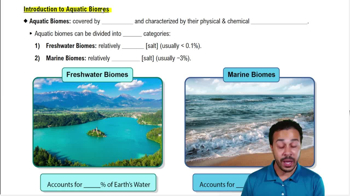
Introduction to Aquatic Biomes

Ecosystem

An ecosystem is a community of living organisms interacting with their physical environment. It includes both biotic factors, like plants and animals, and abiotic factors, such as soil, water, and climate. While temperate forests in different regions share the same biome classification, their ecosystems can differ significantly due to variations in local climate, soil types, and species composition.
추천 영상:
04:07
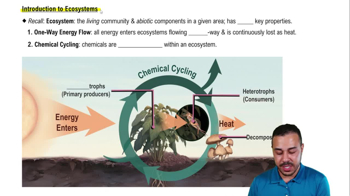
Introduction to Ecosystems

Disturbance and Adaptation

Disturbance refers to events that disrupt ecosystem structure and function, such as fires, storms, or human activities. These disturbances can lead to adaptations in species, influencing biodiversity and ecosystem dynamics. The temperate forests in China and North America may experience different disturbances and adaptations, resulting in distinct ecosystems despite their classification under the same biome.
추천 영상:
가이드 코스
05:24
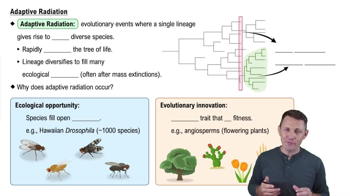
Adaptive Radiation
관련 실천
교과서 질문

Explain how the open ocean is similar to the desert, and how it is not.

1101
views
교과서 질문

Which of these statements about aquatic biomes is true? Select True or False for each statement.

T/F The ocean is so vast that it is not influenced by human impacts.

T/F Water depth, water flow, salinity, and nutrient availability are important abiotic factors in aquatic biomes.

T/F Once nutrients sink to the bottom of lakes, they are no longer available to organisms.

1137
views
교과서 질문

Scientists predict that global climate change will cause a greater increase in average temperature at higher latitudes than in the tropics. This seems like good news since most of the world's biodiversity occurs in the tropics. However, recent data suggest that a smaller temperature change in the tropics will cause a larger physiological response in organisms there than the larger temperature change will in organisms in temperate areas. Based on what you have learned about thermal niches in this chapter, propose a hypothesis to explain this result.

1374
views
교과서 질문

Like Earth, Mars has seasons—its Northern Hemisphere experiences winter when its Southern Hemisphere experiences summer. Which statement is the best explanation for seasonality on Mars?

a. Mars is tilted on its axis.

b. Mars has an elliptical orbit that brings it closer to the Sun in summer than in winter.

c. Mars has a circular orbit and maintains a constant distance from the Sun.

d. The Southern Hemisphere of Mars consistently receives direct solar radiation.

1026
views
교과서 질문

What is one expected consequence of global climate change?

a. Average rainfall will increase.

b. Average rainfall will decrease.

c. Variability in rainfall will increase.

d. We cannot make predictions about future rainfall.

891
views
교과서 질문

Compare the distribution of the natural terrestrial biomes of eastern North America with the distribution of anthropogenic biomes.

656
views