
What do proximate explanations of behavior focus on? a. how displays and other types of behavior have changed through time, or evolved b. the 'adaptive significance' of a behavior c. genetic, neurological, and hormonal mechanisms of behavior d. appropriate experimental methods when studying behavior
Ch. 50 - Behavioral Ecology
50장, 문제 3
A behavior is considered adaptive if it increases an individual's fitness. How is fitness measured? Select True or False for each statement.
T/F Strength
T/F Body size
T/F Speed
T/F Number of viable offspring
검증된 단계별 안내1
Understand the concept of 'fitness' in biology: Fitness refers to an organism's ability to survive and reproduce in its environment. It is often measured by the number of viable offspring an individual can produce.
Evaluate the statement 'strength': Consider whether physical strength directly contributes to an individual's ability to produce viable offspring. While strength might aid in survival, it does not directly measure fitness unless it leads to increased reproduction.
Evaluate the statement 'body size': Consider whether body size directly contributes to an individual's ability to produce viable offspring. Body size might influence survival or mating success, but it is not a direct measure of fitness unless it results in more offspring.
Evaluate the statement 'speed': Consider whether speed directly contributes to an individual's ability to produce viable offspring. Speed might aid in escaping predators or catching prey, but it is not a direct measure of fitness unless it leads to increased reproduction.
Evaluate the statement 'number of viable offspring': This is the direct measure of fitness. The more viable offspring an individual can produce, the higher its fitness, as it contributes to the passing of genes to the next generation.

비슷한 문제에 대한 검증된 영상 답변:
이 영상 해법은 위 문제에 도움이 된다고 튜터들이 추천한 것입니다.
영상 길이:
3m도움이 되었나요?
주요 개념
질문에 올바르게 답하기 위해 반드시 이해해야 하는 핵심 개념들은 다음과 같습니다.
Fitness in Evolutionary Biology
Fitness in evolutionary biology refers to an organism's ability to survive and reproduce in its environment. It is often measured by the number of viable offspring an individual produces, as these offspring carry the individual's genes into future generations. Fitness is a central concept in natural selection, where traits that enhance reproductive success are favored.
추천 영상:
가이드 코스
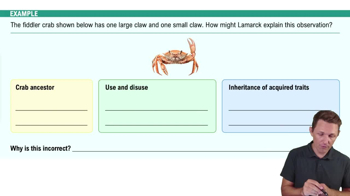
History of Evolutionary Theory Example 1
Adaptive Behavior
Adaptive behavior is any action or trait that increases an individual's fitness by improving its chances of survival and reproduction. Such behaviors are shaped by natural selection and can include physical traits, like speed or strength, and behavioral strategies, like mating rituals or foraging techniques. Adaptive behaviors are context-dependent, varying with environmental pressures.
추천 영상:
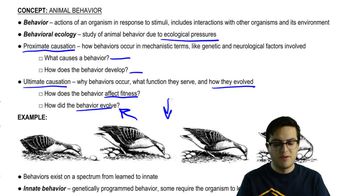
Behavior
Measurement of Fitness
Fitness is measured by the reproductive success of an individual, often quantified by the number of viable offspring produced. While traits like strength, body size, and speed can contribute to fitness, they are not direct measures. Instead, they are factors that may enhance an individual's ability to survive and reproduce, thereby indirectly affecting fitness.
추천 영상:
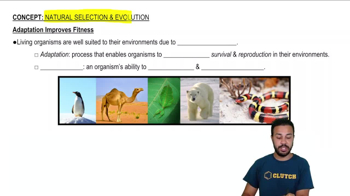
Adaptation Improves Fitness
관련 실천
교과서 질문
1412
views
교과서 질문
Why does altruism seem paradoxical?
a. Sometimes altruistic behavior is actually selfish.
b. Altruism does not actually help others.
c. Alleles that cause an organism to behave altruistically should be selected against since these alleles should lower the organism's fitness.
d. Animals behave altruistically to help the species, but sometimes their behavior harms the species.
1294
views
교과서 질문
Is it true that all organisms forage optimally? Why or why not?
951
views
교과서 질문
The male cuttlefish in the chapter-opening photo can rapidly change their skin colors (under nerve control) to flash warning patterns to rivals. Predict the proximate and ultimate causes of this behavior.
473
views
교과서 질문
What do ultimate explanations of behavior focus on?
997
views
