
Ch. 51 - Population Ecology
Freeman - Biological Science 8th Edition
Freeman8th EditionBiological ScienceISBN: 9780138276263당신이 사용하는 게 아니라요?교과서 변경
51장, 문제 12

<Image>
Burmese pythons (Python molurus bivittatus) are constricting snakes that can reach enormous sizes (up to 7 meters in length). They are native to Southeast Asia but were released into southern Florida from the pet trade. Many other snakes occur naturally in this area. Are the introduced pythons a problem?
Researchers hypothesize that the severe winter of 2010 caused the decline in the number of pythons encountered that year. Is cold weather typically a density-dependent factor or a density-independent factor? Explain the difference.

검증된 단계별 안내
1
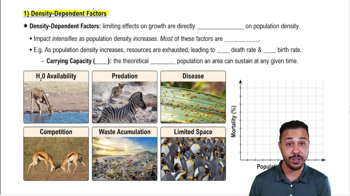
Begin by understanding the concepts of density-dependent and density-independent factors. Density-dependent factors are those that affect the population based on its size. These factors become more intense as the population density increases, such as competition for resources, predation, and disease.
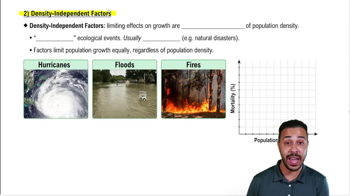
Density-independent factors, on the other hand, affect the population regardless of its size. These are typically abiotic factors such as weather events, natural disasters, and climate conditions.
Consider the impact of cold weather on the Burmese python population. Cold weather is an abiotic factor that can affect the population regardless of its density, making it a density-independent factor.
Reflect on the hypothesis that the severe winter of 2010 caused a decline in the number of pythons. Since cold weather impacts the population regardless of its density, it supports the idea that the decline was due to a density-independent factor.
Conclude by summarizing that cold weather is typically a density-independent factor because it affects populations regardless of their size, unlike density-dependent factors which vary with population density.

비슷한 문제에 대한 검증된 영상 답변:

이 영상 해법은 위 문제에 도움이 된다고 튜터들이 추천한 것입니다.
영상 길이:
1m
도움이 되었나요?

주요 개념

질문에 올바르게 답하기 위해 반드시 이해해야 하는 핵심 개념들은 다음과 같습니다.

Density-Dependent Factors

Density-dependent factors are biological elements that affect population size based on the population density. These factors include competition for resources, predation, disease, and parasitism, which intensify as the population grows. In the context of Burmese pythons, density-dependent factors would influence their survival and reproduction as their numbers increase in Florida.
추천 영상:
가이드 코스
02:37
Density-Dependent Factors

Density-Independent Factors

Density-independent factors impact population size regardless of the population's density. These are typically abiotic factors such as weather, natural disasters, and human activities. For Burmese pythons, cold weather is a density-independent factor because it affects their survival irrespective of how many pythons are present in the area.
추천 영상:
가이드 코스
01:39
Density-Independent Factors

Impact of Invasive Species

Invasive species like Burmese pythons can disrupt local ecosystems by preying on native species, competing for resources, and altering habitat structures. Their introduction in Florida poses ecological challenges, potentially threatening native wildlife and biodiversity. Understanding their impact is crucial for managing and mitigating ecological consequences in affected areas.
추천 영상:
가이드 코스
03:35
Geographic Impact on Communities
관련 실천
교과서 질문

<Image>

Burmese pythons (Python molurus bivittatus) are constricting snakes that can reach enormous sizes (up to 7 meters in length). They are native to Southeast Asia but were released into southern Florida from the pet trade. Many other snakes occur naturally in this area. Are the introduced pythons a problem?

A life table would help researchers make predictions about python population growth. If you were to track a cohort of pythons over time to construct a detailed life table, what kind of data would you want to collect?

661
views
교과서 질문

<Image>

Burmese pythons (Python molurus bivittatus) are constricting snakes that can reach enormous sizes (up to 7 meters in length). They are native to Southeast Asia but were released into southern Florida from the pet trade. Many other snakes occur naturally in this area. Are the introduced pythons a problem?

The data in the graph show the number of pythons that were encountered, not the total number of pythons in the population. Design a mark–recapture experiment to estimate the total population size of pythons, and list at least two assumptions you would be making in your experiment.

651
views
교과서 질문

When wild plant and animal populations are logged, fished, or hunted, only the oldest or largest individuals tend to be taken. Many of the commercially important species are long lived and are slow to begin reproducing. If harvesting is not regulated carefully and exploitation is intense, what impact does harvesting have on a population's age structure? How might harvesting affect the population's life table and growth rate?

1079
views
교과서 질문

Burmese pythons (Python molurus bivittatus) are constricting snakes that can reach enormous sizes (up to 7 meters in length). They are native to Southeast Asia but were released into southern Florida from the pet trade. Many other snakes occur naturally in this area. Are the introduced pythons a problem? Pythons are generalist predators, consuming more than 75 species of prey including frogs, mice, rabbits, squirrels, porcupines, raccoons, leopards, deer, monkeys, alligators, and birds ranging from wrens to herons. Some surveys showed the disappearance of some animals, such as rabbits and opossums, from areas with pythons. Do you think food availability limits, or could limit, the carrying capacity of Burmese pythons in the Everglades?

254
views
교과서 질문

Burmese pythons (Python molurus bivittatus) are constricting snakes that can reach enormous sizes (up to 7 meters in length). They are native to Southeast Asia but were released into southern Florida from the pet trade. Many other snakes occur naturally in this area. Are the introduced pythons a problem? Burmese pythons were first found in the wetlands of Everglades National Park in the 1980s, but only rarely. The accompanying graph shows what happened next. Most of the data are derived from chance encounters of pythons on roads and intermittent search effort near roads (pythons are notoriously difficult to find). Despite the variability in search effort, what type of population growth best describes the trend in the data from 2000 to 2020? a. logistic b. exponential c. linear d. logarithmic


251
views