
Ch. 51 - Population Ecology
Freeman - Biological Science 8th Edition
Freeman8th EditionBiological ScienceISBN: 9780138276263당신이 사용하는 게 아니라요?교과서 변경
51장, 문제 4

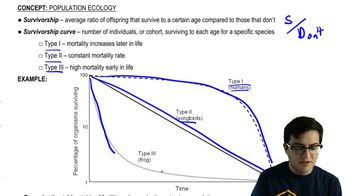
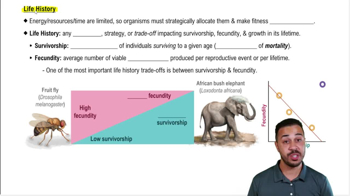
Why is there a trade-off between survivorship and fecundity?

검증된 단계별 안내
1
Understand the concept of life history strategies: Life history strategies are the ways in which organisms allocate resources to growth, reproduction, and survival. These strategies are shaped by evolutionary pressures to maximize fitness in a given environment.
Define survivorship and fecundity: Survivorship refers to the ability of an organism to live through various stages of its life cycle, while fecundity refers to the reproductive capacity of an organism, i.e., the number of offspring it can produce.
Recognize the resource allocation constraint: Organisms have limited resources (such as energy and nutrients) to allocate towards growth, reproduction, and maintenance (including survival). Allocating more resources to one function means fewer resources are available for others.
Examine the trade-off mechanism: If an organism allocates more resources to survivorship (e.g., better immune function, stronger bodily structures), it may have to reduce the resources allocated to fecundity, resulting in fewer offspring. Conversely, if more resources are directed towards producing more offspring, the organism might reduce investment in its own survival mechanisms.
Explore examples and ecological implications: In different environments, the balance of this trade-off can affect the population dynamics and evolutionary outcomes. For example, in stable environments, species might evolve to prioritize survivorship, while in unpredictable environments, high fecundity might be favored to ensure at least some offspring survive.

비슷한 문제에 대한 검증된 영상 답변:

이 영상 해법은 위 문제에 도움이 된다고 튜터들이 추천한 것입니다.
영상 길이:
3m
도움이 되었나요?

주요 개념

질문에 올바르게 답하기 위해 반드시 이해해야 하는 핵심 개념들은 다음과 같습니다.

Survivorship

Survivorship refers to the probability of an individual organism surviving to a particular age. It is a key component of life history strategies, which describe how organisms allocate resources to growth, reproduction, and survival. High survivorship often indicates that an organism has traits that enhance its longevity, such as effective predator avoidance or efficient resource use.
추천 영상:

Fecundity

Fecundity is the reproductive capacity of an organism, typically measured by the number of offspring produced in a given time period. It reflects an organism's ability to reproduce and is influenced by factors such as age, health, and environmental conditions. High fecundity can lead to increased population growth but may also require significant energy investment, impacting survival.
추천 영상:

Life History Trade-offs

Life history trade-offs are the compromises that organisms make between different biological functions, such as growth, reproduction, and survival. For example, investing more energy in reproduction (high fecundity) may reduce the energy available for survival, leading to lower survivorship. Understanding these trade-offs helps explain the diversity of reproductive strategies observed in nature.
추천 영상:
관련 실천
교과서 질문

Pose a hypothesis to explain why the human population has undergone especially rapid growth over the past 200 years. Describe two examples of density-dependent factors that limit human population growth. Is it possible that humans have surpassed Earth's carrying capacity?

811
views
교과서 질문

If most individuals in a population are young, why is the population likely to grow rapidly in the future?

a. Death rates will be low.

b. The population has a skewed age distribution.

c. Immigration and emigration can be ignored.

d. Many individuals will begin to reproduce soon.

1620
views
교과서 질문

In what populations does exponential growth tend to occur?

a. Populations that colonize new habitats

b. Populations that experience intense competition

c. Populations that experience high rates of predation

d. Populations that have surpassed their carrying capacity

1535
views
교과서 질문

Which of the following species is most likely to have a Type III survivorship curve?

a. Humans, Homo sapiens

b. Common lizards, Zootoca vivipara

c. Thale cress plants, Arabidopsis thaliana

d. Lynx cats, Lynx canadensis

1166
views
교과서 질문

What is usually true of exponential growth? Select True or False for each statement.

T/F The population is growing.

T/F The per capita growth rate is constant.

T/F The per capita growth rate increases rapidly over time.

T/F The per capita growth rate is very high.

1525
views
교과서 질문

Explain why biologists want to maintain (a) 'habitat corridors' that connect populations in a metapopulation, and (b) unoccupied habitat that is appropriate for the species in question.

741
views