
Ch. 7 - Inside the Cell
Freeman - Biological Science 8th Edition
Freeman8th EditionBiological ScienceISBN: 9780138276263당신이 사용하는 게 아니라요?교과서 변경
7장, 문제 9

When analyzing a sample of cells from a patient, you find the lysosomes are filled with undigested material. This observation makes you think that the lysosomes are not functioning properly. What are three different defects that could be responsible for malfunctioning lysosomes?

검증된 단계별 안내
1
1. Enzyme Deficiency: Lysosomes contain enzymes that break down waste materials and cellular debris. If these enzymes are deficient or not functioning properly, the lysosomes will not be able to digest the material. This could be due to a genetic disorder, such as a lysosomal storage disease, where the body doesn't produce enough of a specific enzyme.
2. Membrane Damage: The lysosome is surrounded by a membrane that keeps the digestive enzymes separate from the rest of the cell. If this membrane is damaged, the enzymes could leak out and damage the cell, or the undigested material could escape into the cell. This could be caused by physical damage, exposure to toxins, or infection.
3. pH Imbalance: The inside of a lysosome is acidic, which is necessary for the enzymes to function. If the pH balance is off, the enzymes may not work properly. This could be due to a problem with the cell's proton pumps, which are responsible for maintaining the acidic environment.

비슷한 문제에 대한 검증된 영상 답변:

이 영상 해법은 위 문제에 도움이 된다고 튜터들이 추천한 것입니다.
영상 길이:
1m
도움이 되었나요?

주요 개념

질문에 올바르게 답하기 위해 반드시 이해해야 하는 핵심 개념들은 다음과 같습니다.

Lysosomal Function

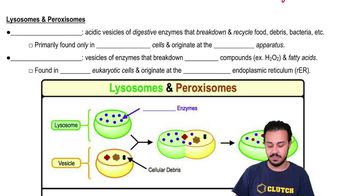
Lysosomes are membrane-bound organelles that contain digestive enzymes responsible for breaking down waste materials and cellular debris. They play a crucial role in cellular homeostasis by recycling macromolecules and removing damaged organelles. Proper lysosomal function is essential for maintaining cellular health and preventing the accumulation of undigested materials.
추천 영상:
05:38
Lysosomes & Peroxisomes

Lysosomal Storage Diseases

Lysosomal storage diseases are a group of inherited metabolic disorders caused by enzyme deficiencies within lysosomes. These deficiencies lead to the accumulation of undigested substrates, resulting in cellular dysfunction and various clinical symptoms. Examples include Tay-Sachs disease and Gaucher's disease, which highlight the importance of specific enzymes for lysosomal activity.
추천 영상:
05:38
Lysosomes & Peroxisomes

Autophagy

Autophagy is a cellular process that involves the degradation and recycling of cellular components through lysosomes. It is essential for maintaining cellular homeostasis, especially during stress conditions. Defects in autophagy can lead to the accumulation of damaged organelles and proteins, contributing to lysosomal dysfunction and the buildup of undigested materials.
관련 실천
교과서 질문

Most of the proteins that enter the nucleus possess a nuclear localization signal (NLS), even if they are small enough to pass through the nuclear pore complex unhindered. Why would a small protein have an NLS, when it naturally diffuses across the nuclear pore complex without one?

2398
views
교과서 질문

The eukaryotic cytoskeleton is a highly dynamic network of filaments and motor proteins. Which of the following correctly describe activities of these cytoskeletal components? Select True or False for each statement.

T/FMyosin motors walk toward the plus ends of intermediate filaments.

T/FDynein motors are responsible for the whip-like movement of eukaryotic flagella.

T/FKinesin motors move vesicles along tracks toward the microtubule-organizing center.

T/FActin filaments are required for cytoplasmic streaming.

1983
views
교과서 질문

Cells that line your intestines are known to possess a large number of membrane proteins that transport small molecules and ions across the plasma membrane. Which of the following cell structures would you expect to be required for this characteristic of the cells?

a. The endoplasmic reticulum

b. Peroxisomes

c. Lysosomes

d. The cell wall

1841
views
교과서 질문

George Palade's research group used the pulse–chase assay to elucidate the secretory pathway in pancreatic cells. If they had instead performed this assay on muscle cells, where would you expect the labeled proteins to end up during the chase?

(Muscle cells consist primarily of actin and myosin filaments and have high energy demands for muscle contraction.)

2021
views