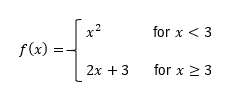
Determine if the functionf(x) is continuous and/or differentiable at x=3.
A
Continuous and non-differentiable
B
Continuous and differentiable
C
Discontinuous and non-differentiable
D
Discontinuous and differentiable
0 댓글
검증된 단계별 안내
1
Step 1: To determine if the function is continuous at x=3, check if the left-hand limit, right-hand limit, and the value of the function at x=3 are equal. The left-hand limit is calculated using f(x) = x^2 for x < 3, and the right-hand limit is calculated using f(x) = 2x + 3 for x ≥ 3.
Step 2: Compute the left-hand limit as x approaches 3 using f(x) = x^2. Substitute x=3 into x^2 to find the limit.
Step 3: Compute the right-hand limit as x approaches 3 using f(x) = 2x + 3. Substitute x=3 into 2x + 3 to find the limit.
Step 4: Compare the left-hand limit, right-hand limit, and the value of f(3) (using f(x) = 2x + 3 for x ≥ 3). If all three are equal, the function is continuous at x=3.
Step 5: To determine differentiability at x=3, check if the derivative from the left-hand side (using f(x) = x^2) and the derivative from the right-hand side (using f(x) = 2x + 3) are equal. If they are not equal, the function is not differentiable at x=3.


 검증된 단계별 안내

