Skip to main content
Statistics for Business
나의 코스
배우기
시험 준비
AI 튜터
학습 가이드
플래시카드
탐험해 보세요
앱을 사용해 보세요
나의 코스
배우기
시험 준비
AI 튜터
학습 가이드
플래시카드
탐험해 보세요
앱을 사용해 보세요
뒤로
Addition Rule quiz
카드를 뒤집기 위해 탭할 수 있습니다.
What does it mean for two events to be mutually exclusive?
카드를 뒤집기 위해 탭할 수 있습니다.
👆
What does it mean for two events to be mutually exclusive?
Mutually exclusive events cannot occur at the same time; if one happens, the other cannot.
진행 상황 추적
컨트롤 버튼이 '내비게이션' 모드로 변경되었습니다.
1/15
관련 플래시카드
관련 실천
추천 영상
Addition Rule definitions
Addition Rule
15 용어
Addition Rule
4. Probability
10 문제점
주제
Ernest
Multiplication Rule: Independent Events
4. Probability
10 문제점
주제
Ernest
4. Probability
9 주제
17 문제점
장
Ernest
VideoThumbView.guidedCourse
5:14
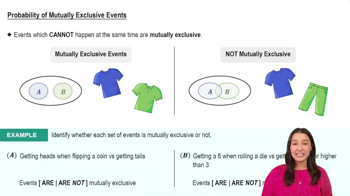
Probability of Mutually Exclusive Events
623
views
16
rank
VideoThumbView.guidedCourse
2:57
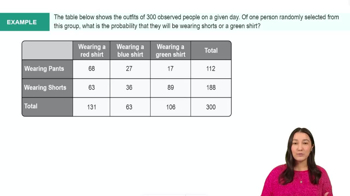
Probability of Non-Mutually Exclusive Events Example
409
views
12
rank
VideoThumbView.guidedCourse
5:14
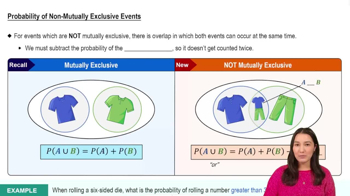
Probability of Non-Mutually Exclusive Events
481
views
14
rank
이 집합의 용어 (15)
하이드의 정의
What does it mean for two events to be mutually exclusive?
Mutually exclusive events cannot occur at the same time; if one happens, the other cannot.
How do you calculate the probability of two mutually exclusive events occurring?
Add the individual probabilities of each event: P(A or B) = P(A) + P(B).
What is the formula for the probability of two non-mutually exclusive events?
P(A or B) = P(A) + P(B) - P(A and B).
Why do you subtract P(A and B) when calculating the probability of non-mutually exclusive events?
Because the overlap (where both events occur) is counted twice when adding P(A) and P(B), so it must be subtracted once.
What does the symbol '∪' represent in probability notation?
The symbol '∪' means 'or' and represents the union of two events.
What does the symbol '∩' represent in probability notation?
The symbol '∩' means 'and' and represents the intersection where both events occur.
If two events are mutually exclusive, what is P(A and B)?
P(A and B) is 0 because both events cannot happen at the same time.
Give an example of two mutually exclusive events.
Getting heads or tails on a single coin flip; you cannot get both at once.
Give an example of two non-mutually exclusive events.
Rolling a six and rolling a number higher than three on a die; rolling a six satisfies both events.
How would you calculate the probability of rolling a 3 or a 5 on a six-sided die?
Add the probabilities: 1/6 (for 3) + 1/6 (for 5) = 2/6 or 1/3.
How do you find the probability of rolling a number greater than 3 or an even number on a six-sided die?
Add the probabilities of each event, then subtract the overlap: 3/6 + 3/6 - 2/6 = 4/6 or 2/3.
What is the general addition rule for any two events?
P(A or B) = P(A) + P(B) - P(A and B), regardless of mutual exclusivity.
When can you use the simple addition rule without subtracting the overlap?
When the events are mutually exclusive, since P(A and B) = 0.
What is 'or probability' in the context of probability rules?
'Or probability' refers to the probability that at least one of two events occurs.
Why is understanding mutually exclusive and non-mutually exclusive events important in probability?
It ensures you use the correct formula and avoid double-counting outcomes when calculating probabilities.
 뒤로뒤로
뒤로뒤로
 5:14
5:14