Skip to main content
Statistics for Business
나의 코스
배우기
시험 준비
AI 튜터
학습 가이드
플래시카드
탐험해 보세요
앱을 사용해 보세요
나의 코스
배우기
시험 준비
AI 튜터
학습 가이드
플래시카드
탐험해 보세요
앱을 사용해 보세요
뒤로
Basic Concepts of Probability definitions
카드를 뒤집기 위해 탭할 수 있습니다.
Probability
카드를 뒤집기 위해 탭할 수 있습니다.
👆
Probability
A numerical measure expressing the likelihood of an event, ranging from 0 (impossible) to 1 (certain).
진행 상황 추적
컨트롤 버튼이 '내비게이션' 모드로 변경되었습니다.
1/14
관련 플래시카드
관련 실천
추천 영상
Basic Concepts of Probability quiz #1
Basic Concepts of Probability
10 용어
Basic Concepts of Probability
4. Probability
10 문제점
주제
Ernest
Complements
4. Probability
10 문제점
주제
Ernest
4. Probability
9 주제
17 문제점
장
Ernest
VideoThumbView.guidedCourse
5:37
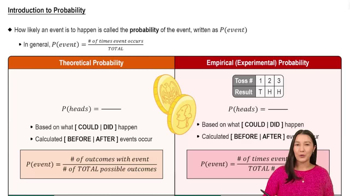
Introduction to Probability
971
views
31
rank
이 집합의 용어 (14)
하이드의 정의
Probability
A numerical measure expressing the likelihood of an event, ranging from 0 (impossible) to 1 (certain).
Event
Any outcome or set of outcomes that can occur in a probability experiment, regardless of size or significance.
Theoretical Probability
A value calculated using possible outcomes before any experiment, based on logical reasoning or known possibilities.
Empirical Probability
A value determined from observed data after conducting trials or experiments, reflecting actual results.
Sample Space
A set containing all possible outcomes of a probability experiment, often shown using curly brackets.
Outcome
A single possible result from a probability experiment, such as rolling a specific number on a die.
Trial
A single performance or repetition of a probability experiment, such as one coin flip or one die roll.
Set Notation
A mathematical way to list all possible outcomes of an experiment, typically using curly brackets.
Fraction
A numerical representation used to express probability, showing favorable outcomes over total possible outcomes.
Decimal
A numerical format often used to report probability values, such as 0.5 or 0.8.
Sample Size
The total number of trials or observations in an experiment, affecting the accuracy of empirical probability.
Data Table
An organized display of observed outcomes from probability experiments, used to calculate empirical probability.
Total Possible Outcomes
The complete count of all distinct results that can occur in a probability experiment.
Favorable Outcomes
The specific results within the sample space that satisfy the condition of interest in a probability question.
 뒤로뒤로
뒤로뒤로
 5:37
5:37