Skip to main content
Statistics for Business
나의 코스
배우기
시험 준비
AI 튜터
학습 가이드
플래시카드
탐험해 보세요
앱을 사용해 보세요
나의 코스
배우기
시험 준비
AI 튜터
학습 가이드
플래시카드
탐험해 보세요
앱을 사용해 보세요
뒤로
Bayes' Theorem quiz
카드를 뒤집기 위해 탭할 수 있습니다.
What does conditional probability allow us to determine?
카드를 뒤집기 위해 탭할 수 있습니다.
👆
What does conditional probability allow us to determine?
Conditional probability allows us to find the likelihood of an event occurring given that another event has already occurred.
진행 상황 추적
컨트롤 버튼이 '내비게이션' 모드로 변경되었습니다.
1/15
관련 플래시카드
관련 실천
추천 영상
Bayes' Theorem definitions
Bayes' Theorem
15 용어
Bayes' Theorem
4. Probability
7 문제점
주제
Ally
Fundamental Counting Principle
4. Probability
10 문제점
주제
Ernest
4. Probability
9 주제
17 문제점
장
Ernest
VideoThumbView.guidedCourse
05:10
Bayes' Theorem
425
views
12
rank
VideoThumbView.guidedCourse
02:32
Bayes' Theorem Example 1
230
views
5
rank
이 집합의 용어 (15)
하이드의 정의
What does conditional probability allow us to determine?
Conditional probability allows us to find the likelihood of an event occurring given that another event has already occurred.
What is the main purpose of Bayes' theorem in probability?
Bayes' theorem relates the probabilities of two events, simplifying the calculation of conditional probabilities.
In Bayes' theorem, what does the numerator represent?
The numerator represents the joint probability of both events A and B occurring.
What does the denominator in Bayes' theorem represent?
The denominator is the probability of the given event, usually event A.
Why might Bayes' theorem be easier to use than the conditional probability rule in some problems?
Bayes' theorem can be easier when direct probabilities for events are not given, but related probabilities are available.
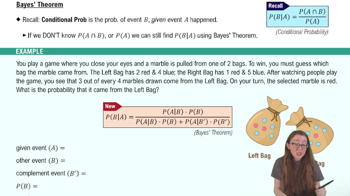
In the marble example, what is the 'given' event (event A)?
The given event is that the selected marble is red.
What is event B in the marble example?
Event B is that the marble came from the left bag.
What is the complement of event B in the marble example?
The complement of event B is that the marble came from the right bag.
How do you calculate the probability of drawing from the left bag in the example?
The probability is three out of four, since three out of every four marbles drawn come from the left bag.
What is the probability of drawing from the right bag in the example?
The probability is one out of four, as it is the complement of drawing from the left bag.
How do you find the probability of drawing a red marble given it came from the left bag?
It is two out of six, since two of the six marbles in the left bag are red.
What is the probability of drawing a red marble given it came from the right bag?
It is one out of six, since only one of the six marbles in the right bag is red.
What formula do you use to find the probability of the marble coming from the left bag given it is red?
You use Bayes' theorem, plugging in the relevant probabilities for each event and their complements.
What is the final probability that the marble came from the left bag given it is red?
The probability is six sevenths, after simplifying the fractions in Bayes' theorem.
Why is it important to correctly identify which event is 'given' in conditional probability problems?
Correctly identifying the 'given' event ensures you use the right probabilities in Bayes' theorem and conditional probability calculations.
 뒤로
뒤로

 05:10
05:10