Skip to main content
Statistics for Business
나의 코스
배우기
시험 준비
AI 튜터
학습 가이드
플래시카드
탐험해 보세요
앱을 사용해 보세요
나의 코스
배우기
시험 준비
AI 튜터
학습 가이드
플래시카드
탐험해 보세요
앱을 사용해 보세요
뒤로
Counting definitions
카드를 뒤집기 위해 탭할 수 있습니다.
Permutation
카드를 뒤집기 위해 탭할 수 있습니다.
👆
Permutation
Arrangement of distinct objects where order is important and each object is used only once.
진행 상황 추적
컨트롤 버튼이 '내비게이션' 모드로 변경되었습니다.
1/15
관련 플래시카드
관련 실천
추천 영상
Counting quiz
Counting
15 용어
Counting
4. Probability
10 문제점
주제
Ernest
Fundamental Counting Principle
4. Probability
10 문제점
주제
Ernest
4. Probability
9 주제
17 문제점
장
Ernest
VideoThumbView.guidedCourse
03:59
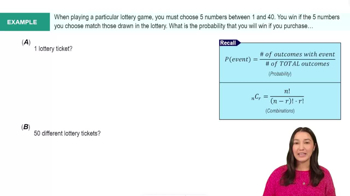
Counting Example 1
236
views
4
rank
VideoThumbView.guidedCourse
03:18
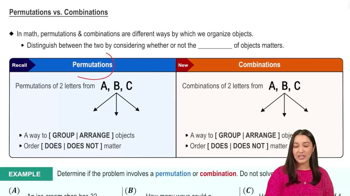
Permutations vs. Combinations
302
views
6
rank
VideoThumbView.guidedCourse
07:11
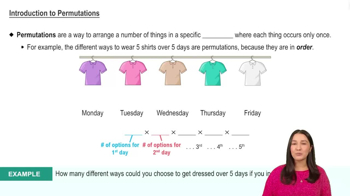
Introduction to Permutations
407
views
7
rank
이 집합의 용어 (15)
하이드의 정의
Permutation
Arrangement of distinct objects where order is important and each object is used only once.
Combination
Grouping of objects where order is irrelevant; only the selection of items matters.
Factorial
Product of all positive integers up to a given number, denoted by an exclamation mark.
Fundamental Counting Principle
Rule stating that the total number of outcomes is the product of the number of choices at each step.
Distinct Objects
Items that are all different from each other, making their arrangement unique.
Non-distinct Objects
Items that are identical, requiring special consideration in counting arrangements.
Permutation Formula
Expression n!/(n−r)! used to calculate arrangements where order matters.
Combination Formula
Expression n!/[r!(n−r)!] used to count groupings where order does not matter.
Notation
Symbols such as P(n, r) or C(n, r) representing permutations or combinations.
Numerator
Top part of a fraction, often representing the total number of arrangements in counting formulas.
Denominator
Bottom part of a fraction, often used to adjust for repeated or unordered selections.
Outcome
A possible result from arranging or selecting objects in a counting problem.
Order
Sequence in which objects are arranged or selected, crucial in distinguishing permutations from combinations.
Selection
Process of choosing objects from a set, regardless of arrangement.
Grouping
Collection of objects considered together, especially when order is not important.
 뒤로뒤로
뒤로뒤로
 03:59
03:59