Skip to main content
Statistics for Business
나의 코스
배우기
시험 준비
AI 튜터
학습 가이드
플래시카드
탐험해 보세요
앱을 사용해 보세요
나의 코스
배우기
시험 준비
AI 튜터
학습 가이드
플래시카드
탐험해 보세요
앱을 사용해 보세요
뒤로
Independence Tests quiz
카드를 뒤집기 위해 탭할 수 있습니다.
What does it mean for two variables to be independent in statistics?
카드를 뒤집기 위해 탭할 수 있습니다.
👆
What does it mean for two variables to be independent in statistics?
It means that the variables do not affect each other in any way.
진행 상황 추적
컨트롤 버튼이 '내비게이션' 모드로 변경되었습니다.
1/15
관련 플래시카드
관련 실천
추천 영상
Independence Tests definitions
Independence Tests
15 용어
Independence Tests
13. Chi-Square Tests & Goodness of Fit
10 문제점
주제
Laura
Homogeneity Tests
13. Chi-Square Tests & Goodness of Fit
5 문제점
주제
13. Chi-Square Tests & Goodness of Fit - Part 1 of 2
3 주제
17 문제점
장
Brendan
13. Chi-Square Tests & Goodness of Fit - Part 2 of 2
1 주제
3 문제점
장
David-Paige
VideoThumbView.guidedCourse
06:28
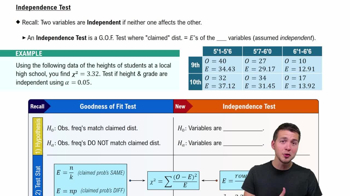
Independence Test
146
views
VideoThumbView.guidedCourse
08:07
Independence Test Example 1
125
views
1
rank
이 집합의 용어 (15)
하이드의 정의
What does it mean for two variables to be independent in statistics?
It means that the variables do not affect each other in any way.
What is the purpose of a chi-square test of independence?
It is used to determine whether two categorical variables are independent or related.
What is the null hypothesis in a test of independence?
The null hypothesis states that the two variables are independent.
How is the alternative hypothesis stated in an independence test?
The alternative hypothesis claims that the variables are dependent.
What test statistic is used in a chi-square test of independence?
The chi-square test statistic is used, calculated from observed and expected frequencies.
How do you calculate expected frequencies in an independence test?
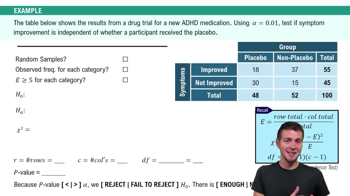
Multiply the row total by the column total and divide by the grand total for each cell.
What is the formula for degrees of freedom in a chi-square test of independence?
Degrees of freedom = (number of rows - 1) × (number of columns - 1).
What do you compare the p-value to when making a decision in a chi-square test?
You compare the p-value to the significance level, alpha.
What conclusion do you draw if the p-value is greater than alpha in an independence test?
You fail to reject the null hypothesis, suggesting insufficient evidence of dependence.
What does it mean to 'fail to reject' the null hypothesis in this context?
It means there is not enough evidence to say the variables are dependent.
What are the main conditions that must be met to run a chi-square test of independence?
You need random samples, observed frequencies for all categories, and expected frequencies of at least 5 in each cell.
How is a chi-square test of independence similar to a goodness of fit test?
Both use the chi-square statistic and compare observed to expected frequencies.
How is the calculation of expected frequencies different in an independence test compared to a goodness of fit test?
In an independence test, expected frequencies are based on row and column totals, not just claimed distributions.
If you have 2 rows and 3 columns in your data table, what are the degrees of freedom?
The degrees of freedom are (2-1) × (3-1) = 2.
Why is it important to check that all expected frequencies are at least 5 in a chi-square test?
This ensures the validity of the test results and that the chi-square approximation is appropriate.
 뒤로뒤로
뒤로뒤로


 06:28
06:28