Skip to main content
Statistics for Business
나의 코스
배우기
시험 준비
AI 튜터
학습 가이드
플래시카드
탐험해 보세요
앱을 사용해 보세요
나의 코스
배우기
시험 준비
AI 튜터
학습 가이드
플래시카드
탐험해 보세요
앱을 사용해 보세요
뒤로
Mode definitions
카드를 뒤집기 위해 탭할 수 있습니다.
Mode
카드를 뒤집기 위해 탭할 수 있습니다.
👆
Mode
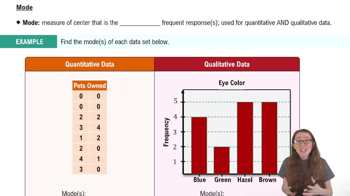
The value in a data set that appears with the highest frequency, indicating the most common observation.
진행 상황 추적
컨트롤 버튼이 '내비게이션' 모드로 변경되었습니다.
1/12
관련 플래시카드
관련 실천
추천 영상
Mode quiz
Mode
15 용어
Mode
3. Describing Data Numerically
5 문제점
주제
David-Paige
Standard Deviation
3. Describing Data Numerically
10 문제점
주제
Jonathan
3. Describing Data Numerically
8 주제
19 문제점
장
Jonathan
VideoThumbView.guidedCourse
03:20
Mode
455
views
5
rank
이 집합의 용어 (12)
하이드의 정의
Mode
The value in a data set that appears with the highest frequency, indicating the most common observation.
Frequency
The number of times a particular value or category occurs within a data set.
Data Set
A collection of related values or observations, often organized for statistical analysis.
Observation
An individual value or measurement recorded within a data set.
Unimodal Distribution
A distribution characterized by a single value occurring most frequently.
Bimodal Distribution
A distribution with two distinct values sharing the highest frequency.
Multimodal Distribution
A distribution containing more than two values that tie for the highest frequency.
Categorical Data
Non-numeric information that can be grouped by categories, often summarized using the most frequent category.
Numerical Data
Quantitative information represented by numbers, suitable for calculating measures like the most common value.
Outlier
A value significantly different from others in a data set, often not affecting the most frequent value.
Central Tendency
A statistical measure that identifies a typical or representative value within a data set.
Nonparametric Measure
A statistic that does not rely on assumptions about the distribution of the underlying data.
 뒤로뒤로
뒤로뒤로

 03:20
03:20