Skip to main content
Statistics for Business
나의 코스
배우기
시험 준비
AI 튜터
학습 가이드
플래시카드
탐험해 보세요
앱을 사용해 보세요
나의 코스
배우기
시험 준비
AI 튜터
학습 가이드
플래시카드
탐험해 보세요
앱을 사용해 보세요
뒤로
Multiple Comparisons: Bonferoni Test definitions
카드를 뒤집기 위해 탭할 수 있습니다.
ANOVA
카드를 뒤집기 위해 탭할 수 있습니다.
👆
ANOVA
A statistical method for comparing means across three or more groups to detect any significant differences among them.
진행 상황 추적
컨트롤 버튼이 '내비게이션' 모드로 변경되었습니다.
1/15
관련 플래시카드
관련 실천
추천 영상
Multiple Comparisons: Bonferoni Test quiz
Multiple Comparisons: Bonferoni Test
15 용어
Multiple Comparisons: Bonferoni Test
14. ANOVA
5 문제점
주제
Two-Way ANOVA
14. ANOVA
5 문제점
주제
Justin
14. ANOVA - Part 1 of 2
1 주제
15 문제점
장
Ally
14. ANOVA - Part 2 of 2
3 주제
9 문제점
장
Justin
VideoThumbView.guidedCourse
09:54
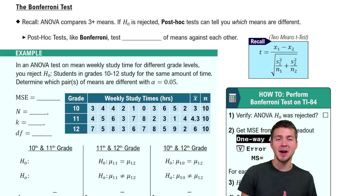
The Bonferroni Test
148
views
VideoThumbView.guidedCourse
08:11
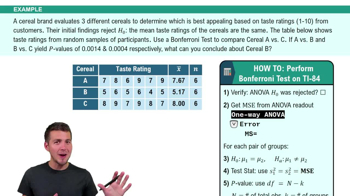
The Bonferroni Test Example 1
87
views
이 집합의 용어 (15)
하이드의 정의
ANOVA
A statistical method for comparing means across three or more groups to detect any significant differences among them.
Null Hypothesis
An initial claim stating all group means are equal, serving as the baseline for statistical testing.
Post Hoc Test
A follow-up analysis performed after rejecting the main hypothesis to identify which specific group means differ.
Bonferroni Test
A correction method for multiple comparisons that adjusts significance levels to control the chance of false positives.
Pairwise Comparison
An analysis involving the evaluation of all possible pairs of group means to determine where differences exist.
Mean Square Error
A value from ANOVA representing the average of squared differences within groups, used as a variance estimate.
Degrees of Freedom
A parameter based on sample size and number of groups, crucial for determining critical values in statistical tests.
Test Statistic
A calculated value, such as a t-score, used to assess the evidence against the null hypothesis in each comparison.
P Value
A probability measure indicating the likelihood of observing the data if the null hypothesis is true.
Adjusted P Value
A modified probability accounting for multiple tests, typically found by multiplying the original value by the number of comparisons.
Alpha Level
A threshold probability, often set at 0.05, used to decide whether to reject the null hypothesis.
Sample Size
The number of observations in each group, impacting the calculation of test statistics and error estimates.
Combinations
A mathematical concept used to count the number of unique pairs formed from several groups for comparison.
Two-Tailed Test
A statistical test that considers differences in both directions, checking for any inequality between group means.
Variance Within
The measure of variability among data points inside each group, reflected by the mean square error in ANOVA.
 뒤로뒤로
뒤로뒤로

 09:54
09:54