Skip to main content
Statistics for Business
나의 코스
배우기
시험 준비
AI 튜터
학습 가이드
플래시카드
탐험해 보세요
앱을 사용해 보세요
나의 코스
배우기
시험 준비
AI 튜터
학습 가이드
플래시카드
탐험해 보세요
앱을 사용해 보세요
뒤로
Multiplication Rule: Independent Events quiz
카드를 뒤집기 위해 탭할 수 있습니다.
What does it mean for two events to be independent?
카드를 뒤집기 위해 탭할 수 있습니다.
👆
What does it mean for two events to be independent?
Two events are independent if the outcome of one does not affect the outcome of the other.
진행 상황 추적
컨트롤 버튼이 '내비게이션' 모드로 변경되었습니다.
1/15
관련 플래시카드
관련 실천
추천 영상
Multiplication Rule: Independent Events definitions
Multiplication Rule: Independent Events
15 용어
Multiplication Rule: Independent Events
4. Probability
10 문제점
주제
Ernest
Introduction to Contingency Tables
4. Probability
5 문제점
주제
Ernest
4. Probability
9 주제
17 문제점
장
Ernest
VideoThumbView.guidedCourse
05:54
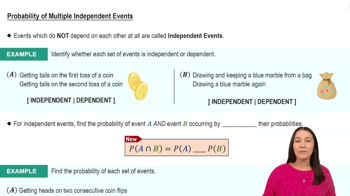
Probability of Multiple Independent Events
643
views
18
rank
이 집합의 용어 (15)
하이드의 정의
What does it mean for two events to be independent?
Two events are independent if the outcome of one does not affect the outcome of the other.
How do you calculate the probability of two independent events both occurring?
Multiply the probability of the first event by the probability of the second event.
What is the probability of getting heads on two consecutive coin flips?
The probability is (1/2) × (1/2) = 1/4 or 0.25.
What is 'and probability' in the context of independent events?
'And probability' refers to the probability that both events occur, calculated by multiplying their individual probabilities.
How can you tell if two events are dependent?
Two events are dependent if the outcome of one affects the probability of the other.
What is the probability of rolling an even number and then a three on a six-sided die?
The probability is (3/6) × (1/6) = 3/36 or 0.08.
If you draw and keep a blue marble, then draw again, are these events independent?
No, because removing a marble changes the probability for the second draw, making the events dependent.
What symbol is often used in set notation to represent 'and' probability?
The upside down 'U' symbol (∩) is used to represent 'and' probability.
How do you find the probability of three independent events all occurring?
Multiply the probabilities of all three events together.
Why is the probability of getting heads on two coin flips 1/4?
Because there are four possible outcomes and only one is heads on both flips.
What is the probability of rolling a three on a six-sided die?
The probability is 1/6.
If the outcome of one event does not change the probability of another, what are the events called?
They are called independent events.
What do you do if you need to find the 'and probability' for more than two independent events?
Continue multiplying the probability of each event together.
Give an example of two independent events.
Flipping a coin and rolling a die are independent because one does not affect the other.
What is the probability of getting tails on the first coin flip and heads on the second?
The probability is (1/2) × (1/2) = 1/4.
 뒤로뒤로
뒤로뒤로
 05:54
05:54