Skip to main content
Statistics for Business
나의 코스
배우기
시험 준비
AI 튜터
학습 가이드
플래시카드
탐험해 보세요
앱을 사용해 보세요
나의 코스
배우기
시험 준비
AI 튜터
학습 가이드
플래시카드
탐험해 보세요
앱을 사용해 보세요
뒤로
Two Means - Matched Pairs (Dependent Samples) definitions
카드를 뒤집기 위해 탭할 수 있습니다.
Matched Pairs
카드를 뒤집기 위해 탭할 수 있습니다.
👆
Matched Pairs
Samples where each value in one group is uniquely paired with a value in another, often through before-and-after or related individuals.
진행 상황 추적
컨트롤 버튼이 '내비게이션' 모드로 변경되었습니다.
1/15
관련 플래시카드
관련 실천
추천 영상
Two Means - Matched Pairs (Dependent Samples) quiz
Two Means - Matched Pairs (Dependent Samples)
15 용어
Two Means - Matched Pairs (Dependent Samples)
10. Hypothesis Testing for Two Samples
10 문제점
주제
Laura
10. Hypothesis Testing for Two Samples - Part 1 of 2
3 주제
15 문제점
장
Ally
10. Hypothesis Testing for Two Samples - Part 2 of 2
3 주제
8 문제점
장
Justin
VideoThumbView.guidedCourse
08:33
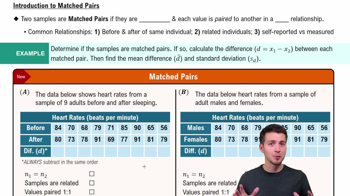
Introduction to Matched Pairs
175
views
VideoThumbView.guidedCourse
05:03
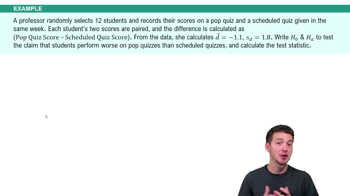
Matched Pairs: Hypothesis Tests Example 2
104
views
VideoThumbView.guidedCourse
07:23
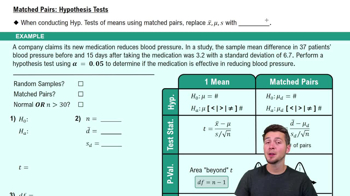
Matched Pairs: Hypothesis Tests
128
views
2
rank
이 집합의 용어 (15)
하이드의 정의
Matched Pairs
Samples where each value in one group is uniquely paired with a value in another, often through before-and-after or related individuals.
One-to-One Relationship
A direct pairing between values in two samples, ensuring each value is linked to exactly one counterpart.
Mean Difference
The average of the differences calculated between each matched pair, serving as the central measure in analysis.
Sample Mean Difference
The computed average of all individual differences in matched pairs, denoted as d-bar.
Standard Deviation of Differences
A measure of variability among the differences in matched pairs, represented as s sub d.
Null Hypothesis
The default claim that there is no difference between paired values, typically stating the mean difference equals zero.
Alternative Hypothesis
A claim suggesting a significant change or difference exists between paired values, challenging the null hypothesis.
Confidence Interval
A range constructed around the sample mean difference, estimating where the true population mean difference likely falls.
Margin of Error
The product of the critical t-value and the standard deviation of differences divided by the square root of the number of pairs.
Critical t-value
A cutoff from the t-distribution, based on confidence level and degrees of freedom, used in interval and error calculations.
Degrees of Freedom
A value calculated as the number of pairs minus one, used to select the appropriate t-distribution.
p-value
The probability, under the null hypothesis, of observing a test statistic as extreme as the one calculated from the data.
Level of Significance
A threshold, often denoted alpha, used to decide whether to reject the null hypothesis based on the p-value.
Point Estimator
A single value, such as the sample mean difference, used as the best guess for the population parameter.
Independent Samples
Groups where values in one sample have no unique pairing or relationship with values in the other sample.
 뒤로뒤로
뒤로뒤로


 08:33
08:33