Skip to main content
Statistics for Business
나의 코스
배우기
시험 준비
AI 튜터
학습 가이드
플래시카드
탐험해 보세요
앱을 사용해 보세요
나의 코스
배우기
시험 준비
AI 튜터
학습 가이드
플래시카드
탐험해 보세요
앱을 사용해 보세요
뒤로
Statistics for Business - Mean and Standard Deviation
카드를 뒤집기 위해 탭할 수 있습니다.
What is the formula for the mean of a data set?
카드를 뒤집기 위해 탭할 수 있습니다.
👆
What is the formula for the mean of a data set?
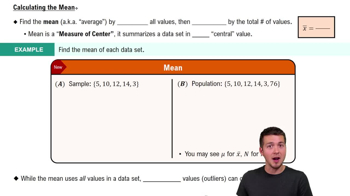
The mean is calculated as \(\bar{x} = \frac{\sum x}{n}\), where
\(\sum\) x
is the sum of all data values and
n
is the number of values.
진행 상황 추적
컨트롤 버튼이 '내비게이션' 모드로 변경되었습니다.
1/20
추천 영상
VideoThumbView.guidedCourse
03:08
Calculating the Mean Example 1
459
views
22
rank
VideoThumbView.guidedCourse
04:52
Calculating the Mean
669
views
15
rank
이 집합의 용어 (20)
하이드의 정의
What is the formula for the mean of a data set?
The mean is calculated as \(\bar{x} = \frac{\sum x}{n}\), where
\(\sum\) x
is the sum of all data values and
n
is the number of values.
How do you calculate the mean of the data set {5, 10, 14, 12, 3}?
Sum the values: 5 + 10 + 14 + 12 + 3 = 44, then divide by 5. Mean = \(\frac{44}{5} = 8.8\).
What is the effect of adding an outlier to a data set on the mean?
Adding an outlier (extreme value) can significantly change the mean, making it less representative of the data.
What is the formula for sample standard deviation?
Sample standard deviation is \(s = \sqrt{\frac{1}{n-1} \sum (x - \bar{x})^2}\), measuring how spread out data values are around the mean.
What does a larger standard deviation indicate about a data set?
A larger standard deviation means the data values are more spread out from the mean.
Calculate the deviations from the mean for the data set {5, 10, 12, 14, 3} if the mean is 8.8.
Deviations: 5 - 8.8 = -3.8, 10 - 8.8 = 1.2, 12 - 8.8 = 3.2, 14 - 8.8 = 5.2, 3 - 8.8 = -5.8.
How do you calculate the squared deviations for the data set {5, 10, 12, 14, 3} with mean 8.8?
Square each deviation: (-3.8)^2=14.44, 1.2^2=1.44, 3.2^2=10.24, 5.2^2=27.04, (-5.8)^2=33.64.
What is the sum of squared deviations for the data set {5, 10, 12, 14, 3} with mean 8.8?
Sum = 14.44 + 1.44 + 10.24 + 27.04 + 33.64 = 86.8.
How do you calculate the sample variance from squared deviations?
Sample variance = sum of squared deviations divided by (n - 1), where n is the number of data points.
Calculate the sample variance for the data set {5, 10, 12, 14, 3} with sum of squared deviations 86.8.
Variance = \(\frac{86.8}{5-1} = 21.7\).
How do you find the sample standard deviation from the variance?
Standard deviation is the square root of the variance.
Calculate the sample standard deviation for variance 21.7.
Standard deviation = \(\sqrt{21.7} \approx 4.66\).
What is the difference between population and sample standard deviation formulas?
Population uses \(N\) in denominator; sample uses \(n-1\) to correct bias.
What does the symbol
\(\bar{x}\)
represent in statistics?
\(\bar{x}\)
represents the sample mean, the average of sample data values.
What does the symbol
s
represent in statistics?
s
represents the sample standard deviation, a measure of data spread in a sample.
Why is the sample standard deviation always greater than or equal to zero?
Because it is a square root of squared deviations, which are always non-negative.
What is the meaning of the summation symbol
\(\sum\)
in the mean formula?
\(\sum\)
means to add all the values of the variable x in the data set.
How do you interpret a standard deviation of zero?
All data values are identical; there is no spread.
What is the first step in calculating the mean of a data set?
Sum all the data values.
What is the second step in calculating the mean of a data set?
Divide the sum by the number of data values.
 뒤로뒤로
뒤로뒤로
 03:08
03:08