Skip to main content
Calculus
나의 코스
배우기
시험 준비
AI 튜터
학습 가이드
교과서적 해결책
플래시카드
탐험해 보세요
앱을 사용해 보세요
나의 코스
배우기
시험 준비
AI 튜터
학습 가이드
교과서적 해결책
플래시카드
탐험해 보세요
앱을 사용해 보세요
뒤로
Calculus in Polar Coordinates quiz
카드를 뒤집기 위해 탭할 수 있습니다.
What is the general form for expressing a point in polar coordinates?
카드를 뒤집기 위해 탭할 수 있습니다.
👆
What is the general form for expressing a point in polar coordinates?
A point in polar coordinates is given as (r, θ), where r is the radial distance from the origin and θ is the angle from the positive x-axis.
진행 상황 추적
컨트롤 버튼이 '내비게이션' 모드로 변경되었습니다.
1/15
관련 플래시카드
관련 실천
추천 영상
Calculus in Polar Coordinates definitions
Calculus in Polar Coordinates
15 용어
Calculus in Polar Coordinates
16. Parametric Equations & Polar Coordinates
5 문제점
주제
Ernest
Conic Sections
16. Parametric Equations & Polar Coordinates
5 문제점
주제
Ernest
16. Parametric Equations & Polar Coordinates
5 주제
14 문제점
장
Justin
VideoThumbView.guidedCourse
12:18
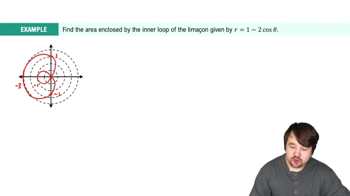
Area of Polar Regions Example 2
208
views
3
rank
1
comments
VideoThumbView.guidedCourse
09:04
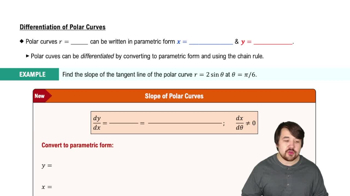
Slope of Polar Curves
263
views
4
rank
VideoThumbView.guidedCourse
05:58
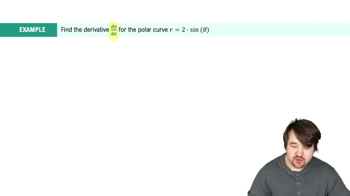
Slope of Polar Curves Example 1
239
views
4
rank
이 집합의 용어 (15)
하이드의 정의
What is the general form for expressing a point in polar coordinates?
A point in polar coordinates is given as (r, θ), where r is the radial distance from the origin and θ is the angle from the positive x-axis.
How do you convert a polar curve r = f(θ) into parametric equations for x and y?
Set x = f(θ) cos(θ) and y = f(θ) sin(θ).
What formula is used to find the slope of the tangent line to a polar curve?
The slope is given by dy/dx = (dy/dθ) / (dx/dθ).
When differentiating y = f(θ) sin(θ), what rule do you use?
Use the product rule: derivative of the first times the second plus the first times the derivative of the second.
What is the derivative of y = 2 sin²(θ) with respect to θ?
The derivative is 4 sin(θ) cos(θ), which can also be written as 2 sin(2θ).
How do you find dx/dθ if x = 2 sin(θ) cos(θ)?
dx/dθ = 2 cos(2θ), using the double angle identity for sine.
What trigonometric identity allows you to simplify 2 sin(θ) cos(θ)?
2 sin(θ) cos(θ) = sin(2θ).
If dy/dθ = 2 sin(2θ) and dx/dθ = 2 cos(2θ), what is dy/dx?
dy/dx = tan(2θ).
What is the slope of the tangent line to r = 2 sin(θ) at θ = π/6?
The slope is tan(π/3), which equals √3.
What is the formula for the area of a region bounded by a polar curve r = f(θ) from θ = α to θ = β?
A = (1/2) ∫[α to β] r² dθ.
How do you set up the integral to find the area of one petal of the rose r = 4 sin(2θ)?
Set up the integral as (1/2) ∫[0 to π/2] (4 sin(2θ))² dθ.
What is the value of (4 sin(2θ))²?
It is 16 sin²(2θ).
What trigonometric identity is used to integrate sin²(2θ)?
sin²(2θ) = (1 - cos(4θ))/2.
After applying the identity and simplifying, what does the area integral for one petal of r = 4 sin(2θ) become?
It becomes 4 ∫[0 to π/2] (1 - cos(4θ)) dθ.
What is the area of one petal of the rose curve r = 4 sin(2θ)?
The area is 2π.
 뒤로뒤로
뒤로뒤로
 12:18
12:18