Skip to main content
Calculus
나의 코스
배우기
시험 준비
AI 튜터
학습 가이드
교과서적 해결책
플래시카드
탐험해 보세요
앱을 사용해 보세요
나의 코스
배우기
시험 준비
AI 튜터
학습 가이드
교과서적 해결책
플래시카드
탐험해 보세요
앱을 사용해 보세요
뒤로
Convergence Tests quiz
카드를 뒤집기 위해 탭할 수 있습니다.
What is the formula for the sequence discussed in the lesson?
카드를 뒤집기 위해 탭할 수 있습니다.
👆
What is the formula for the sequence discussed in the lesson?
The formula is a_n = n^2 × (n-1)!
진행 상황 추적
컨트롤 버튼이 '내비게이션' 모드로 변경되었습니다.
1/15
관련 플래시카드
관련 실천
추천 영상
Convergence Tests definitions
Convergence Tests
15 용어
Convergence Tests
14. Sequences & Series
5 문제점
주제
Jonathan
Series
14. Sequences & Series
5 문제점
주제
Ernest
14. Sequences & Series
4 주제
12 문제점
장
Ernest
VideoThumbView.guidedCourse
05:35
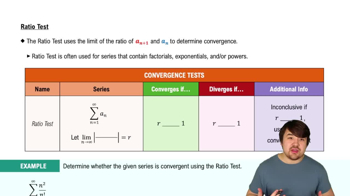
Ratio Test
507
views
12
rank
VideoThumbView.guidedCourse
09:25
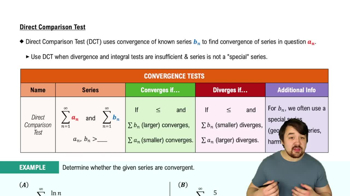
Direct Comparison Test
635
views
14
rank
VideoThumbView.guidedCourse
10:07
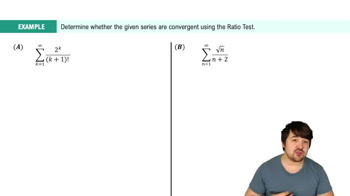
Ratio Test Example 1
345
views
10
rank
이 집합의 용어 (15)
하이드의 정의
What is the formula for the sequence discussed in the lesson?
The formula is a_n = n^2 × (n-1)!
How do you find the first term of the sequence a_n = n^2 × (n-1)!?
Plug in n = 1 to get a_1 = 1^2 × 0! = 1 × 1 = 1.
What is the value of zero factorial (0!)?
Zero factorial is defined as 1.
Calculate the second term of the sequence a_n = n^2 × (n-1)!.
a_2 = 2^2 × 1! = 4 × 1 = 4.
What is the value of one factorial (1!)?
One factorial is 1.
How do you calculate the third term of the sequence a_n = n^2 × (n-1)!?
Plug in n = 3 to get a_3 = 3^2 × 2! = 9 × 2 = 18.
What is the value of two factorial (2!)?
Two factorial is 2 × 1 = 2.
Calculate the fourth term of the sequence a_n = n^2 × (n-1)!.
a_4 = 4^2 × 3! = 16 × 6 = 96.
What is the value of three factorial (3!)?
Three factorial is 3 × 2 × 1 = 6.
List the first four terms of the sequence a_n = n^2 × (n-1)!.
The first four terms are 1, 4, 18, and 96.
Is it acceptable to have a factorial in a sequence formula?
Yes, it is perfectly fine to have a factorial in a sequence.
What operation do you perform first when evaluating a_n = n^2 × (n-1)! for a given n?
First, calculate n^2, then multiply by (n-1) factorial.
Why is understanding factorials important in sequences?
Understanding factorials is crucial for grasping concepts in combinatorics and probability.
What do you do if you encounter (n-1)! in a sequence formula?
You substitute n-1 for n, then compute the factorial of that value.
How do you continue the sequence a_n = n^2 × (n-1)! beyond the first four terms?
You keep plugging in higher values of n into the formula to find subsequent terms.
 뒤로뒤로
뒤로뒤로
 05:35
05:35