Skip to main content
Calculus
나의 코스
배우기
시험 준비
AI 튜터
학습 가이드
교과서적 해결책
플래시카드
탐험해 보세요
앱을 사용해 보세요
나의 코스
배우기
시험 준비
AI 튜터
학습 가이드
교과서적 해결책
플래시카드
탐험해 보세요
앱을 사용해 보세요
뒤로
Exponential & Logarithmic Equations quiz
카드를 뒤집기 위해 탭할 수 있습니다.
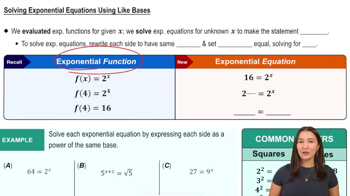
What is the first step when solving an exponential equation like 16 = 2^x?
카드를 뒤집기 위해 탭할 수 있습니다.
👆
What is the first step when solving an exponential equation like 16 = 2^x?
Rewrite both sides of the equation to have the same base, if possible.
진행 상황 추적
컨트롤 버튼이 '내비게이션' 모드로 변경되었습니다.
1/15
관련 플래시카드
관련 실천
추천 영상
Exponential & Logarithmic Equations definitions
Exponential & Logarithmic Equations
15 용어
Exponential & Logarithmic Equations
0. Functions
3 문제점
주제
Ernest
Introduction to Trigonometric Functions
0. Functions
5 문제점
주제
Ally
0. Functions - Part 1 of 2
7 주제
14 문제점
장
Patrick
0. Functions - Part 2 of 2
8 주제
12 문제점
장
David-Paige
4:46
Solving Exponential Equations Using Like Bases
1105
views
10
rank
5:02
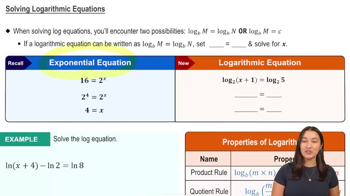
Solving Logarithmic Equations
879
views
7
rank
5:47
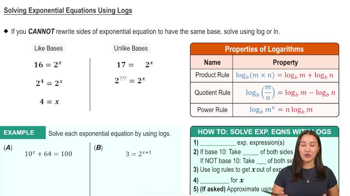
Solving Exponential Equations Using Logs
924
views
8
rank
이 집합의 용어 (15)
하이드의 정의
What is the first step when solving an exponential equation like 16 = 2^x?
Rewrite both sides of the equation to have the same base, if possible.
After rewriting both sides of an exponential equation to have the same base, what do you do next?
Set the exponents equal to each other and solve the resulting linear equation.
How can you rewrite 64 as a power of 2?
64 can be rewritten as 2^6.
If you have 5^(x+1) = sqrt(5), how do you rewrite the right side to have the same base?
Rewrite sqrt(5) as 5^(1/2).
What should you do if you cannot rewrite both sides of an exponential equation to have the same base?
Use logarithms to solve for the variable.
What is the first step when using logarithms to solve an exponential equation like 10^x + 64 = 100?
Isolate the exponential expression on one side of the equation.
When should you use the common log (log) versus the natural log (ln) when solving exponential equations?
Use the common log for base 10 and the natural log for other bases.
What log property allows you to bring the exponent down in front when solving for x in an equation like log(10^x)?
The power rule: log(a^b) = b*log(a).
How do you solve for x in the equation log(10^x) = log(36)?
Since log(10) = 1, x = log(36).
What is the general process for solving a logarithmic equation where two logs of the same base are set equal?
Set the arguments of the logs equal to each other and solve the resulting equation.
How do you solve an equation like ln(x+4) - ln(2) = ln(8)?
Use the quotient rule to combine logs, then set the arguments equal: (x+4)/2 = 8.
What is the next step after combining logs in a logarithmic equation and setting the arguments equal?
Solve the resulting linear equation for the variable.
How do you solve a logarithmic equation like log_2(4x) = 5?
Rewrite it in exponential form: 2^5 = 4x, then solve for x.
Why must you check your solution when solving logarithmic equations?
Because the argument of the log must be positive; if plugging in your solution gives a negative, it is not valid.
What are the two main types of logarithmic equations you may encounter?
Equations with two logs of the same base set equal, and equations with a single log set equal to a constant.
 뒤로뒤로
뒤로뒤로

 4:46
4:46