Skip to main content
Calculus
나의 코스
배우기
시험 준비
AI 튜터
학습 가이드
교과서적 해결책
플래시카드
탐험해 보세요
앱을 사용해 보세요
나의 코스
배우기
시험 준비
AI 튜터
학습 가이드
교과서적 해결책
플래시카드
탐험해 보세요
앱을 사용해 보세요
뒤로
Introduction to Volume & Disk Method quiz
카드를 뒤집기 위해 탭할 수 있습니다.
What is the general approach to finding the volume of a three-dimensional solid using calculus?
카드를 뒤집기 위해 탭할 수 있습니다.
👆
What is the general approach to finding the volume of a three-dimensional solid using calculus?
We use integrals to sum the volumes of thin slices of the solid, each with a known cross-sectional area.
진행 상황 추적
컨트롤 버튼이 '내비게이션' 모드로 변경되었습니다.
1/15
관련 플래시카드
관련 실천
추천 영상
Introduction to Volume & Disk Method definitions
Introduction to Volume & Disk Method
15 용어
Introduction to Volume & Disk Method
9. Graphical Applications of Integrals
5 문제점
주제
Justin
Area Between Curves
9. Graphical Applications of Integrals
5 문제점
주제
Zachary
9. Graphical Applications of Integrals
2 주제
6 문제점
장
Justin
04:53
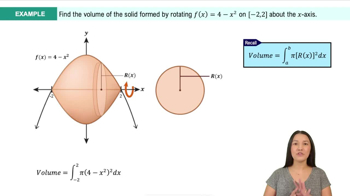
Finding Volume Using Disks Example 3
713
views
16
rank
02:27
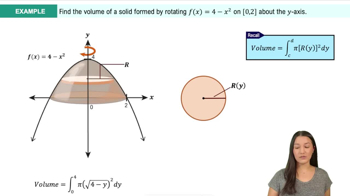
Disk Method Using y-Axis Example 5
463
views
17
rank
05:38
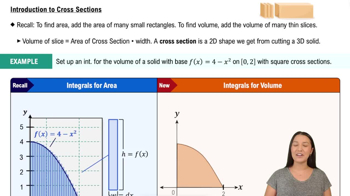
Introduction to Cross Sections
1602
views
43
rank
1
comments
이 집합의 용어 (15)
하이드의 정의
What is the general approach to finding the volume of a three-dimensional solid using calculus?
We use integrals to sum the volumes of thin slices of the solid, each with a known cross-sectional area.
How do you find the area function for a solid with square cross sections?
The area function is the square of the function defining the base, so A(x) = [f(x)]².
What is a cross section in the context of finding volumes?
A cross section is a two-dimensional shape obtained by slicing into a three-dimensional solid.
How do you set up the volume integral for a solid with square cross sections?
Integrate the area function A(x) over the interval, so V = ∫[a to b] [f(x)]² dx.
What is the disk method used for?
The disk method is used to find the volume of solids of revolution with circular cross sections.
How is a solid of revolution formed?
It is formed by revolving a function around an axis, such as the x-axis or y-axis.
What is the area function for a circular cross section in the disk method?
The area function is π[r(x)]², where r(x) is the radius from the curve to the axis of revolution.
How do you determine the radius function r(x) when revolving around the x-axis?
The radius is the distance from the curve to the axis, so r(x) = f(x) minus the axis value (often y = 0).
What is the volume integral for revolving f(x) = 4 - x² from x = -2 to x = 2 about the x-axis?
V = ∫[-2 to 2] π[4 - x²]² dx.
What changes when you revolve a function around the y-axis instead of the x-axis?
The radius function must be written in terms of y, and the integral is with respect to y.
How do you rewrite f(x) = 4 - x² in terms of y for the disk method about the y-axis?
Solve for x: x = √(4 - y), which becomes the function g(y) for the radius.
What are the bounds for the volume integral when revolving f(x) = 4 - x² from x = 0 to x = 2 about the y-axis?
The bounds are y = 0 to y = 4, corresponding to the range of the function.
How do you set up the volume integral for revolving around the y-axis using the disk method?
V = ∫[0 to 4] π[√(4 - y)]² dy.
Why do the squared and square root cancel in the integral for the disk method about the y-axis?
Squaring the square root of (4 - y) gives (4 - y), simplifying the integrand.
What is the key step in setting up any volume integral using cross sections?
Identify the area function for the cross section and integrate it over the appropriate interval.
 뒤로뒤로
뒤로뒤로
 04:53
04:53