Skip to main content
Calculus
나의 코스
배우기
시험 준비
AI 튜터
학습 가이드
교과서적 해결책
플래시카드
탐험해 보세요
앱을 사용해 보세요
나의 코스
배우기
시험 준비
AI 튜터
학습 가이드
교과서적 해결책
플래시카드
탐험해 보세요
앱을 사용해 보세요
뒤로
Inverse Trigonometric Functions quiz
카드를 뒤집기 위해 탭할 수 있습니다.
What interval are the angles returned by the inverse cosine function restricted to?
카드를 뒤집기 위해 탭할 수 있습니다.
👆
What interval are the angles returned by the inverse cosine function restricted to?
The angles returned by the inverse cosine function are restricted to the interval [0, π].
진행 상황 추적
컨트롤 버튼이 '내비게이션' 모드로 변경되었습니다.
1/15
관련 플래시카드
관련 실천
추천 영상
Inverse Trigonometric Functions definitions
Inverse Trigonometric Functions
15 용어
Inverse Trigonometric Functions
0. Functions
3 문제점
주제
Jonathan
Trigonometric Identities
0. Functions
2 문제점
주제
0. Functions - Part 1 of 2
7 주제
14 문제점
장
Patrick
0. Functions - Part 2 of 2
8 주제
12 문제점
장
David-Paige
1:58
Example 1
633
views
4
rank
3:17
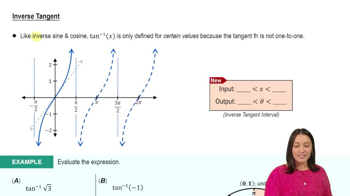
Inverse Tangent
804
views
5
rank
4:49
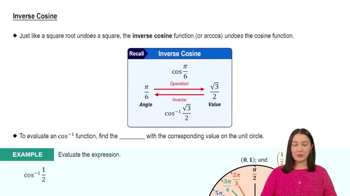
Inverse Cosine
1269
views
14
rank
이 집합의 용어 (15)
하이드의 정의
What interval are the angles returned by the inverse cosine function restricted to?
The angles returned by the inverse cosine function are restricted to the interval [0, π].
What values can be input into the inverse sine function?
The input values for the inverse sine function must be between -1 and 1.
What is the output interval for the inverse sine function?
The output angles for the inverse sine function are between -π/2 and π/2.
What is the output interval for the inverse tangent function?
The output angles for the inverse tangent function are between -π/2 and π/2.
What is the inverse cosine of 1/2?
The inverse cosine of 1/2 is π/3, since π/3 is within the interval [0, π].
What is the inverse sine of 1/2?
The inverse sine of 1/2 is π/6, since π/6 is within the interval [-π/2, π/2].
What is the inverse sine of -√2/2?
The inverse sine of -√2/2 is -π/4, since -π/4 is within the interval [-π/2, π/2].
What is the inverse tangent of √3?
The inverse tangent of √3 is π/3, since π/3 is within the interval [-π/2, π/2].
What is the inverse tangent of -1?
The inverse tangent of -1 is -π/4, since -π/4 is within the interval [-π/2, π/2].
How do you evaluate composite functions like sin(cos⁻¹(1/2))?
Evaluate the inner function first (cos⁻¹(1/2) = π/3), then apply the outer function (sin(π/3) = √3/2).
What is the cosine of the inverse tangent of 0?
The cosine of the inverse tangent of 0 is 1, since tan⁻¹(0) = 0 and cos(0) = 1.
What is the inverse cosine of the sine of π/3?
The sine of π/3 is √3/2, and the inverse cosine of √3/2 is π/6.
Why can't you simply cancel inverse trig functions with their corresponding trig functions in composite expressions?
You must consider the interval for which the inverse function is defined; simply canceling may give an incorrect answer.
What is the inverse cosine of the cosine of 11π/6?
The cosine of 11π/6 is √3/2, and the inverse cosine of √3/2 is π/6, not 11π/6.
What happens if you try to evaluate the inverse sine of 2?
The inverse sine of 2 is undefined because 2 is outside the interval [-1, 1] for valid input values.
 뒤로뒤로
뒤로뒤로


 1:58
1:58