Skip to main content
Calculus
나의 코스
배우기
시험 준비
AI 튜터
학습 가이드
교과서적 해결책
플래시카드
탐험해 보세요
앱을 사용해 보세요
나의 코스
배우기
시험 준비
AI 튜터
학습 가이드
교과서적 해결책
플래시카드
탐험해 보세요
앱을 사용해 보세요
뒤로
Logarithmic Functions quiz
카드를 뒤집기 위해 탭할 수 있습니다.
What is the inverse operation of an exponential function?
카드를 뒤집기 위해 탭할 수 있습니다.
👆
What is the inverse operation of an exponential function?
The inverse operation of an exponential function is taking the logarithm (log).
진행 상황 추적
컨트롤 버튼이 '내비게이션' 모드로 변경되었습니다.
1/15
관련 플래시카드
관련 실천
추천 영상
Logarithmic Functions definitions
Logarithmic Functions
14 용어
Logarithmic Functions
0. Functions
4 문제점
주제
Ernest
Properties of Logarithms
0. Functions
4 문제점
주제
Ernest
0. Functions - Part 1 of 2
7 주제
14 문제점
장
Patrick
0. Functions - Part 2 of 2
8 주제
12 문제점
장
David-Paige
7:30
Logarithms Introduction
1322
views
30
rank
2:51
The Natural Log
922
views
19
rank
5:26
Graphs of Logarithmic Functions
874
views
18
rank
이 집합의 용어 (15)
하이드의 정의
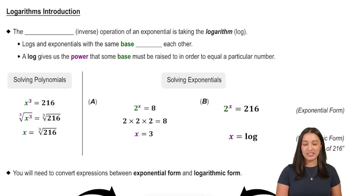
What is the inverse operation of an exponential function?
The inverse operation of an exponential function is taking the logarithm (log).
How do you isolate x in the equation 2^x = 216 using logarithms?
Take the log base 2 of both sides to get x = log base 2 of 216.
What does log base 2 of 216 represent?
It represents the power to which 2 must be raised to get 216.
How do you convert the exponential equation 3^x = 81 to logarithmic form?
It becomes log base 3 of 81 equals x, or log₃(81) = x.
How do you convert x = log base 4 of 64 to exponential form?
It becomes 4^x = 64.
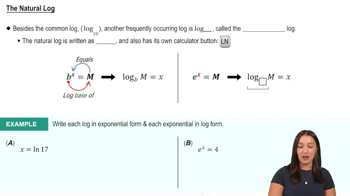
What is the common logarithm and how is it written?
The common logarithm is log base 10, and it is written simply as log.
What is the natural logarithm and how is it denoted?
The natural logarithm is log base e and is denoted as ln.
How do you convert x = ln(17) to exponential form?
It becomes e^x = 17.
How do you convert e^x = 4 to logarithmic form?
It becomes ln(4) = x.
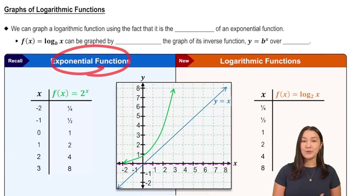
What is the relationship between the graphs of exponential and logarithmic functions?
The graph of a logarithmic function is the reflection of its corresponding exponential function across the line y = x.
What is the domain and range of a logarithmic function?
The domain is (0, ∞) and the range is all real numbers (−∞, ∞).
Where is the vertical asymptote of a logarithmic function located?
The vertical asymptote is at x = 0.
How does the base of a logarithmic function affect its graph?
If the base is greater than 1, the graph increases; if the base is between 0 and 1, the graph decreases.
What is always true about log base b of 1 for any base b?
log base b of 1 is always 0, regardless of the base.
How do you remember the notation for the natural logarithm?
Take the first letters of 'natural log', reverse them, and you get 'ln'.
 뒤로뒤로
뒤로뒤로

 7:30
7:30