Skip to main content
Calculus
나의 코스
배우기
시험 준비
AI 튜터
학습 가이드
교과서적 해결책
플래시카드
탐험해 보세요
앱을 사용해 보세요
나의 코스
배우기
시험 준비
AI 튜터
학습 가이드
교과서적 해결책
플래시카드
탐험해 보세요
앱을 사용해 보세요
뒤로
Motion Analysis quiz
카드를 뒤집기 위해 탭할 수 있습니다.
What is the relationship between position, velocity, and acceleration in motion analysis?
카드를 뒤집기 위해 탭할 수 있습니다.
👆
What is the relationship between position, velocity, and acceleration in motion analysis?
Position is s(t), velocity is the first derivative of position (v = ds/dt), and acceleration is the second derivative of position (a = d^2s/dt^2).
진행 상황 추적
컨트롤 버튼이 '내비게이션' 모드로 변경되었습니다.
1/15
관련 플래시카드
관련 실천
추천 영상
Motion Analysis definitions
Motion Analysis
15 용어
Motion Analysis
4. Applications of Derivatives
3 문제점
주제
Justin
Implicit Differentiation
4. Applications of Derivatives
4 문제점
주제
David-Paige
4. Applications of Derivatives
5 주제
10 문제점
장
Justin
VideoThumbView.guidedCourse
06:29
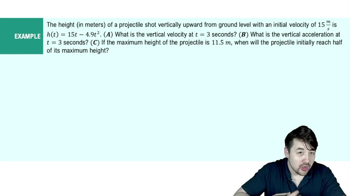
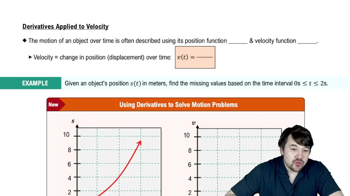
Derivatives Applied To Velocity
1510
views
32
rank
VideoThumbView.guidedCourse
06:51
Derivatives Applied To Acceleration Example 2
808
views
11
rank
VideoThumbView.guidedCourse
06:15
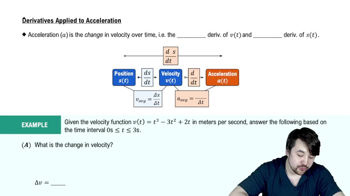
Derivatives Applied To Acceleration
934
views
24
rank
이 집합의 용어 (15)
하이드의 정의
What is the relationship between position, velocity, and acceleration in motion analysis?
Position is s(t), velocity is the first derivative of position (v = ds/dt), and acceleration is the second derivative of position (a = d^2s/dt^2).
How do you find the velocity function from a position function?
Take the first derivative of the position function with respect to time; v(t) = ds/dt.
What does the position function s(t) represent in motion analysis?
It represents the location of an object at a given time t.
How is displacement calculated over a time interval?
Displacement is the final position minus the initial position: s(final) - s(initial).
What is the formula for average velocity over a time interval?
Average velocity is the change in position divided by the change in time: (s(final) - s(initial)) / (t(final) - t(initial)).
How do you find instantaneous velocity at a specific time?
Plug the specific time into the velocity function; v(t) at that time gives the instantaneous velocity.
What is the difference between speed and velocity?
Speed is the absolute value of velocity and always positive, while velocity can be negative or positive depending on direction.
How do you calculate speed from velocity?
Take the absolute value of the velocity; speed = |v|.
What is the mathematical definition of acceleration?
Acceleration is the first derivative of velocity or the second derivative of position with respect to time.
How do you find the change in velocity over a time interval?
Subtract the initial velocity from the final velocity: v(final) - v(initial).
What is the formula for average acceleration?
Average acceleration is the change in velocity divided by the change in time: (v(final) - v(initial)) / (t(final) - t(initial)).
What are the units for acceleration in motion analysis?
Acceleration is measured in distance per squared time, such as meters per second squared (m/s^2).
How do you find the acceleration function from a velocity function?
Take the first derivative of the velocity function with respect to time; a(t) = dv/dt.
How do you calculate instantaneous acceleration at a specific time?
Plug the specific time into the acceleration function; a(t) at that time gives the instantaneous acceleration.
What is the difference between average and instantaneous values in motion analysis?
Average values are calculated over a time interval between two points, while instantaneous values are calculated at a single specific point in time.
 뒤로
뒤로
 06:29
06:29