Skip to main content
Calculus
나의 코스
배우기
시험 준비
AI 튜터
학습 가이드
교과서적 해결책
플래시카드
탐험해 보세요
앱을 사용해 보세요
나의 코스
배우기
시험 준비
AI 튜터
학습 가이드
교과서적 해결책
플래시카드
탐험해 보세요
앱을 사용해 보세요
뒤로
Review of Factorials quiz
1 학생이 이 점이 도움이 되었다고 느꼈습니다
카드를 뒤집기 위해 탭할 수 있습니다.
What mathematical operation does the exclamation point represent when placed after a number or variable?
카드를 뒤집기 위해 탭할 수 있습니다.
👆
What mathematical operation does the exclamation point represent when placed after a number or variable?
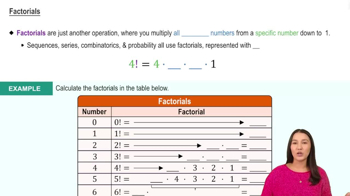
It represents the factorial operation, which multiplies all whole numbers from the given number down to one.
진행 상황 추적
컨트롤 버튼이 '내비게이션' 모드로 변경되었습니다.
1/15
관련 플래시카드
관련 실천
추천 영상
Review of Factorials definitions
Review of Factorials
15 용어
Review of Factorials
14. Sequences & Series
5 문제점
주제
Ernest
Series
14. Sequences & Series
5 문제점
주제
Ernest
14. Sequences & Series
4 주제
12 문제점
장
Ernest
5:22
Factorials
462
views
16
rank
1
comments
이 집합의 용어 (15)
하이드의 정의
What mathematical operation does the exclamation point represent when placed after a number or variable?
It represents the factorial operation, which multiplies all whole numbers from the given number down to one.
How do you calculate 4 factorial (4!)?
Multiply 4 × 3 × 2 × 1, which equals 24.
What is the value of 1 factorial (1!)?
1 factorial is equal to 1.
How do you compute 2 factorial (2!)?
Multiply 2 × 1, which equals 2.
What is the value of 3 factorial (3!)?
3 factorial is equal to 6 (3 × 2 × 1).
What is the value of 5 factorial (5!)?
5 factorial is equal to 120 (5 × 4 × 3 × 2 × 1).
What pattern do you notice when calculating consecutive factorials?
Each factorial is the previous factorial multiplied by the new number.
How can you express n factorial (n!) in terms of (n-1)!?
n! = n × (n-1)!
How can you simplify 4 × 3 factorial (4 × 3!)?
It is equal to 4 factorial (4!), which is 24.
How do you simplify 100 factorial divided by 99 factorial (100! / 99!)?
It simplifies to 100, since 100! = 100 × 99! and 99! cancels out.
What is the value of zero factorial (0!)?
Zero factorial is defined as 1.
Why is 0! defined as 1?
It follows from the factorial formula and is necessary for consistency in combinatorics and probability.
In which areas of mathematics are factorials commonly used?
Factorials are commonly used in sequences, series, combinatorics, and probability.
What is the result of 6 factorial (6!)?
6 factorial is 720 (6 × 5 × 4 × 3 × 2 × 1).
How does the formula n! = n × (n-1)! help simplify factorial expressions?
It allows you to break down large factorials into smaller ones, making calculations easier.
 뒤로뒤로
뒤로뒤로
 5:22
5:22