Calculus
나의 코스
배우기
시험 준비
AI 튜터
학습 가이드
교과서적 해결책
플래시카드
탐험해 보세요
앱을 사용해 보세요
나의 코스
배우기
시험 준비
AI 튜터
학습 가이드
교과서적 해결책
플래시카드
탐험해 보세요
앱을 사용해 보세요
뒤로
Tangent Lines and Derivatives definitions
1 학생이 이 점이 도움이 되었다고 느꼈습니다
카드를 뒤집기 위해 탭할 수 있습니다.
Secant Line
카드를 뒤집기 위해 탭할 수 있습니다.
👆
Secant Line
A straight path intersecting a curve at two distinct points, used to find average rate of change.
진행 상황 추적
컨트롤 버튼이 '내비게이션' 모드로 변경되었습니다.
1/15
관련 플래시카드
관련 실천
추천 영상
Tangent Lines and Derivatives quiz #1
Tangent Lines and Derivatives
10 용어
Tangent Lines and Derivatives
2. Intro to Derivatives
4 문제점
주제
Ernest
Derivatives as Functions
2. Intro to Derivatives
3 문제점
주제
David-Paige
2. Intro to Derivatives
4 주제
7 문제점
장
Jonathan
05:13
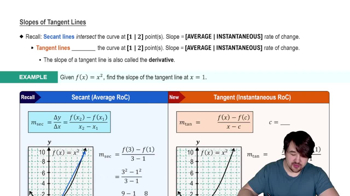
Slopes of Tangent Lines
5029
views
136
rank
05:10
Determine Continuity Algebraically Example 1
1945
views
83
rank
05:14
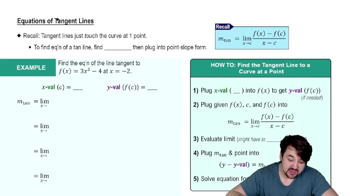
Equations of Tangent Lines
2688
views
74
rank
이 집합의 용어 (15)
하이드의 정의
Secant Line
A straight path intersecting a curve at two distinct points, used to find average rate of change.
Tangent Line
A straight path touching a curve at exactly one point, representing instantaneous rate of change.
Slope
A measure of steepness for a line, calculated as the ratio of vertical to horizontal change.
Limit
A mathematical process describing the value a function approaches as the input nears a specific point.
Derivative
A value representing the instantaneous rate of change of a function at a specific input.
Point-Slope Form
An equation format for a line using a known point and the line's slope to express its relationship.
Difference of Squares
An algebraic expression of the form a^2 - b^2, which factors into (a + b)(a - b).
Indeterminate Form
An expression like 0/0, which lacks a defined value and requires algebraic manipulation to resolve.
Average Rate of Change
A value describing how a function changes between two points, found using a secant line.
Instantaneous Rate of Change
A value describing how a function changes at a single point, found using a tangent line or derivative.
Function
A rule assigning each input exactly one output, often written as f(x).
Factoring
A process of rewriting an expression as a product of simpler expressions, often to simplify limits.
Cancellation
A simplification step where common factors in the numerator and denominator are removed.
Numerator
The top part of a fraction, representing the quantity being divided.
Denominator
The bottom part of a fraction, indicating the number of equal parts the whole is divided into.