Ch. 1 - Functions
Briggs - Calculus: Early Transcendentals 3rd Edition
Briggs3rd EditionCalculus: Early TranscendentalsISBN: 9780136847243당신이 사용하는 게 아니라요?교과서 변경
1장, 문제 1.25

Defining piecewise functions Write a definition of the function whose graph is given <IMAGE>

검증된 단계별 안내
1
Step 1: Identify the different segments of the graph. Look for changes in the slope, discontinuities, or any other features that indicate a new piece of the function.
Step 2: Determine the mathematical expression for each segment. This could be a linear equation, a quadratic, or another type of function, depending on the shape of the graph.
Step 3: Identify the domain for each piece of the function. This involves determining the x-values over which each segment is defined.
Step 4: Write the piecewise function using the expressions and domains identified in the previous steps. Use the format: \( f(x) = \begin{cases} \text{expression 1,} & \text{if } \text{domain 1} \\ \text{expression 2,} & \text{if } \text{domain 2} \\ \end{cases} \)
Step 5: Verify the piecewise function by checking that it matches the graph over the specified domains. Ensure continuity or note any discontinuities as needed.

비슷한 문제에 대한 검증된 영상 답변:

이 영상 해법은 위 문제에 도움이 된다고 튜터들이 추천한 것입니다.
영상 길이:
4m
도움이 되었나요?

주요 개념

질문에 올바르게 답하기 위해 반드시 이해해야 하는 핵심 개념들은 다음과 같습니다.

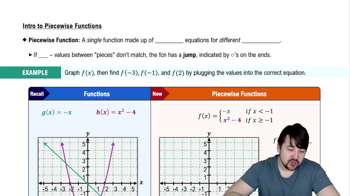
Piecewise Functions

A piecewise function is defined by multiple sub-functions, each applying to a specific interval of the function's domain. This means that the function can take different forms based on the input value. For example, a piecewise function might be defined as f(x) = x^2 for x < 0 and f(x) = 2x + 1 for x ≥ 0, illustrating how the function behaves differently in different regions.
추천 영상:
05:36
Piecewise Functions

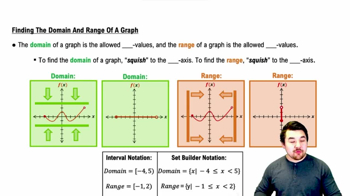
Domain and Range

The domain of a function refers to the set of all possible input values (x-values) for which the function is defined, while the range is the set of all possible output values (y-values). Understanding the domain and range is crucial for defining piecewise functions, as each piece may have its own specific domain, affecting how the function behaves overall.
추천 영상:
5:10
Finding the Domain and Range of a Graph

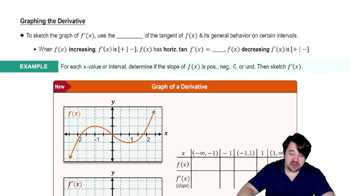
Graph Interpretation

Interpreting the graph of a function involves analyzing its shape, slopes, and intercepts to understand its behavior. For piecewise functions, the graph may consist of distinct segments, each corresponding to different rules. Recognizing where these segments start and end is essential for accurately defining the function and understanding its continuity and discontinuities.
추천 영상:
06:15
Graphing The Derivative