Ch. 1 - Functions
Briggs - Calculus: Early Transcendentals 3rd Edition
Briggs3rd EditionCalculus: Early TranscendentalsISBN: 9780136847243당신이 사용하는 게 아니라요?교과서 변경
1장, 문제 78

Evaluating inverse trigonometric functions Without using a calculator, evaluate the following expressions.
csc1(1)\(\csc\)^{-1}\(\left\)(-1\(\right\))

검증된 단계별 안내
1
Understand that \( \csc^{-1}(x) \) is the inverse cosecant function, which gives the angle \( \theta \) such that \( \csc(\theta) = x \).
Recall that \( \csc(\theta) = \frac{1}{\sin(\theta)} \). Therefore, \( \csc^{-1}(-1) \) means we are looking for an angle \( \theta \) where \( \sin(\theta) = -1 \).
The sine function \( \sin(\theta) \) equals \(-1\) at specific angles. Consider the unit circle: \( \sin(\theta) = -1 \) at \( \theta = \frac{3\pi}{2} \) (or \( 270^\circ \)).
Verify that \( \theta = \frac{3\pi}{2} \) is within the range of the inverse cosecant function. The principal range for \( \csc^{-1}(x) \) is \([-\frac{\pi}{2}, \frac{\pi}{2}] \) excluding \( 0 \), but for negative values, we consider angles in the third and fourth quadrants.
Conclude that the angle \( \theta = \frac{3\pi}{2} \) satisfies the condition \( \csc(\theta) = -1 \), and thus \( \csc^{-1}(-1) = \frac{3\pi}{2} \).

비슷한 문제에 대한 검증된 영상 답변:

이 영상 해법은 위 문제에 도움이 된다고 튜터들이 추천한 것입니다.
영상 길이:
2m
도움이 되었나요?

주요 개념

질문에 올바르게 답하기 위해 반드시 이해해야 하는 핵심 개념들은 다음과 같습니다.

Inverse Trigonometric Functions

Inverse trigonometric functions, such as arcsin, arccos, and arccsc, are the functions that reverse the action of the corresponding trigonometric functions. For example, if y = sin(x), then x = arcsin(y). These functions are defined for specific ranges to ensure they are one-to-one, allowing for unique outputs for each input.
추천 영상:
06:35
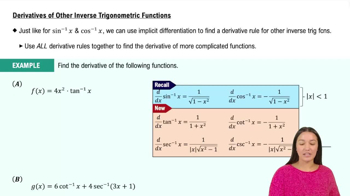
Derivatives of Other Inverse Trigonometric Functions

Cosecant Function

The cosecant function, denoted as csc(x), is the reciprocal of the sine function, defined as csc(x) = 1/sin(x). It is important to note that csc(x) is undefined where sin(x) = 0. The cosecant function is particularly relevant when evaluating expressions involving inverse cosecant, such as csc^{-1}(-1).
추천 영상:
가이드 코스
6:22
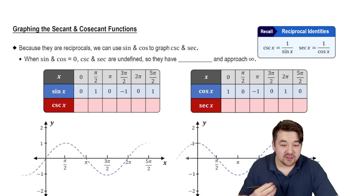
Graphs of Secant and Cosecant Functions

Range of Inverse Cosecant

The range of the inverse cosecant function, csc^{-1}(x), is limited to the intervals (-∞, -1] and [1, ∞). This means that csc^{-1}(x) can only yield values outside the interval (-1, 1), which is crucial when evaluating expressions like csc^{-1}(-1), as it indicates the specific angle whose cosecant is -1.
추천 영상:
4:49
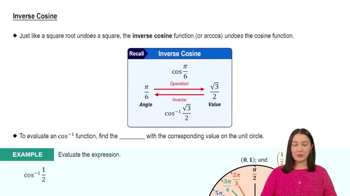
Inverse Cosine