
Ch. 1 - Functions
Briggs - Calculus: Early Transcendentals 3rd Edition
Briggs3rd EditionCalculus: Early TranscendentalsISBN: 9780136847243당신이 사용하는 게 아니라요?교과서 변경
1장, 문제 75

Evaluating inverse trigonometric functions Without using a calculator, evaluate the following expressions.
tan13\(\tan\)^{-1}\(\sqrt\)3

검증된 단계별 안내
1
Understand that \( \tan^{-1}(x) \) represents the angle whose tangent is \( x \). Therefore, \( \tan^{-1}(\sqrt{3}) \) is the angle whose tangent is \( \sqrt{3} \).
Recall the special angles and their tangent values. The tangent of \( \frac{\pi}{3} \) (or 60 degrees) is \( \sqrt{3} \).
Since \( \tan^{-1}(\sqrt{3}) \) is asking for the angle whose tangent is \( \sqrt{3} \), and we know that \( \tan(\frac{\pi}{3}) = \sqrt{3} \), the angle is \( \frac{\pi}{3} \).
Verify that \( \frac{\pi}{3} \) is within the range of the inverse tangent function, which is \( \left(-\frac{\pi}{2}, \frac{\pi}{2}\right) \). Since \( \frac{\pi}{3} \) is within this range, it is a valid solution.
Conclude that \( \tan^{-1}(\sqrt{3}) = \frac{\pi}{3} \).

비슷한 문제에 대한 검증된 영상 답변:

이 영상 해법은 위 문제에 도움이 된다고 튜터들이 추천한 것입니다.
영상 길이:
3m
도움이 되었나요?

주요 개념

질문에 올바르게 답하기 위해 반드시 이해해야 하는 핵심 개념들은 다음과 같습니다.

Inverse Trigonometric Functions

Inverse trigonometric functions, such as an^{-1} (arctan), are used to find the angle whose tangent is a given number. These functions are essential in calculus for solving problems involving angles and their relationships to sides in right triangles. Understanding their ranges and properties is crucial for evaluating expressions without a calculator.
추천 영상:
06:35
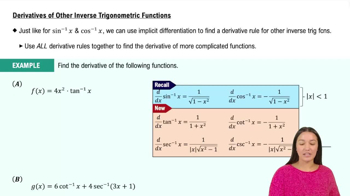
Derivatives of Other Inverse Trigonometric Functions

Special Angles in Trigonometry

Special angles, such as 30°, 45°, and 60°, have known sine, cosine, and tangent values that are often used in trigonometric evaluations. For example, an(60°) = √3, which directly relates to the expression an^{-1}√3. Familiarity with these angles allows for quick evaluations and simplifications in trigonometric problems.
추천 영상:
가이드 코스
6:04
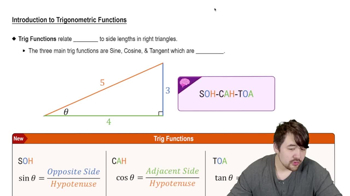
Introduction to Trigonometric Functions

Quadrants and Angle Values

The unit circle divides the plane into four quadrants, each corresponding to specific angle values and signs for sine, cosine, and tangent. Knowing which quadrant an angle lies in helps determine the correct value of inverse trigonometric functions. For instance, an^{-1}√3 corresponds to an angle in the first quadrant, where both sine and cosine are positive.
추천 영상:
5:30
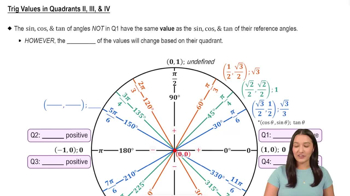
Trig Values in Quadrants II, III, & IV