Ch. 1 - Functions
Briggs - Calculus: Early Transcendentals 3rd Edition
Briggs3rd EditionCalculus: Early TranscendentalsISBN: 9780136847243당신이 사용하는 게 아니라요?교과서 변경
1장, 문제 1.87

Finding all inverses Find all the inverses associated with the following functions, and state their domains.


ƒ(x) = (x + 1)³

검증된 단계별 안내
1
Step 1: To find the inverse of the function \( f(x) = (x + 1)^3 \), start by replacing \( f(x) \) with \( y \). This gives us the equation \( y = (x + 1)^3 \).
Step 2: Swap the variables \( x \) and \( y \) to begin solving for the inverse. This results in the equation \( x = (y + 1)^3 \).
Step 3: Solve for \( y \) by taking the cube root of both sides to isolate \( y + 1 \). This gives \( \sqrt[3]{x} = y + 1 \).
Step 4: Isolate \( y \) by subtracting 1 from both sides of the equation. This results in \( y = \sqrt[3]{x} - 1 \).
Step 5: The inverse function is \( f^{-1}(x) = \sqrt[3]{x} - 1 \). The domain of the inverse function is all real numbers, \( \mathbb{R} \), since the cube root function is defined for all real numbers.

비슷한 문제에 대한 검증된 영상 답변:

이 영상 해법은 위 문제에 도움이 된다고 튜터들이 추천한 것입니다.
영상 길이:
3m
도움이 되었나요?

주요 개념

질문에 올바르게 답하기 위해 반드시 이해해야 하는 핵심 개념들은 다음과 같습니다.

Inverse Functions

An inverse function essentially reverses the effect of the original function. If a function f takes an input x and produces an output y, the inverse function f⁻¹ takes y back to x. For a function to have an inverse, it must be one-to-one, meaning each output is produced by exactly one input.
추천 영상:
4:49
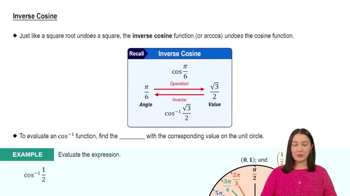
Inverse Cosine

Finding Inverses Algebraically

To find the inverse of a function algebraically, you typically replace f(x) with y, then solve for x in terms of y. After isolating x, you swap x and y to express the inverse function. This process often involves algebraic manipulation and may require checking for restrictions on the domain.
추천 영상:
4:49
Inverse Cosine

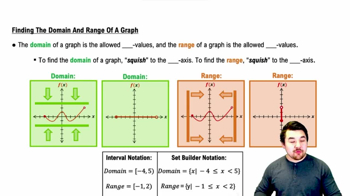
Domain and Range

The domain of a function is the set of all possible input values (x-values), while the range is the set of all possible output values (y-values). When finding the inverse of a function, the domain of the original function becomes the range of the inverse, and vice versa. Understanding these concepts is crucial for accurately determining the domains of both the original and inverse functions.
추천 영상:
가이드 코스
5:10
Finding the Domain and Range of a Graph