Ch. 1 - Functions
Briggs - Calculus: Early Transcendentals 3rd Edition
Briggs3rd EditionCalculus: Early TranscendentalsISBN: 9780136847243당신이 사용하는 게 아니라요?교과서 변경
1장, 문제 1.3.59

Solving equations Solve the following equations.


3(ˣ³⁻⁴) = 15

검증된 단계별 안내
1
Step 1: Start by isolating the exponential expression. Divide both sides of the equation by 3 to simplify: \( \frac{3(x^3 - 4)}{3} = \frac{15}{3} \).
Step 2: Simplify the equation from Step 1. This results in \( x^3 - 4 = 5 \).
Step 3: Solve for \( x^3 \) by adding 4 to both sides of the equation: \( x^3 = 5 + 4 \).
Step 4: Simplify the right side of the equation from Step 3: \( x^3 = 9 \).
Step 5: Solve for \( x \) by taking the cube root of both sides: \( x = \sqrt[3]{9} \).

비슷한 문제에 대한 검증된 영상 답변:

이 영상 해법은 위 문제에 도움이 된다고 튜터들이 추천한 것입니다.
영상 길이:
2m
도움이 되었나요?

주요 개념

질문에 올바르게 답하기 위해 반드시 이해해야 하는 핵심 개념들은 다음과 같습니다.

Exponential Equations

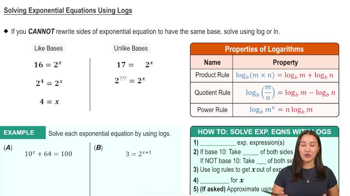
Exponential equations involve variables in the exponent, such as x in the expression a^x. To solve these equations, one often uses logarithms to isolate the variable. Understanding the properties of exponents and logarithms is crucial for manipulating and solving these types of equations.
추천 영상:
5:47
Solving Exponential Equations Using Logs

Isolating the Variable

Isolating the variable is a fundamental algebraic technique used to solve equations. This involves rearranging the equation to get the variable on one side and all other terms on the opposite side. In the given equation, this means simplifying and dividing to find the value of x.
추천 영상:
04:16
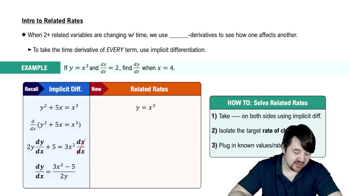
Intro To Related Rates

Properties of Equality

The properties of equality state that if two expressions are equal, then one can be manipulated without changing the equality. This includes adding, subtracting, multiplying, or dividing both sides of the equation by the same non-zero number. These properties are essential for solving equations systematically.
추천 영상:
06:21
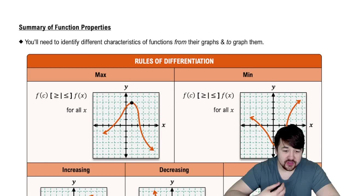
Properties of Functions