
Ch. 1 - Functions
Briggs - Calculus: Early Transcendentals 3rd Edition
Briggs3rd EditionCalculus: Early TranscendentalsISBN: 9780136847243당신이 사용하는 게 아니라요?교과서 변경
1장, 문제 1.41c

Identify the symmetry (if any) in the graphs of the following equations.
y2−4x2=4y^2-4x^2=4

검증된 단계별 안내
1
First, recognize that the given equation is in the form of a conic section. Specifically, it resembles the equation of a hyperbola: \( y^2 - 4x^2 = 4 \).
To analyze symmetry, consider the standard forms of symmetry: symmetry about the x-axis, y-axis, and the origin. For hyperbolas, symmetry is typically about the axes or the origin.
Check for symmetry about the x-axis by replacing \( y \) with \( -y \) in the equation. Substitute \( -y \) into the equation: \( (-y)^2 - 4x^2 = 4 \). Simplify to see if the equation remains unchanged.
Check for symmetry about the y-axis by replacing \( x \) with \( -x \) in the equation. Substitute \( -x \) into the equation: \( y^2 - 4(-x)^2 = 4 \). Simplify to see if the equation remains unchanged.
Check for symmetry about the origin by replacing both \( x \) with \( -x \) and \( y \) with \( -y \). Substitute into the equation: \( (-y)^2 - 4(-x)^2 = 4 \). Simplify to see if the equation remains unchanged. Analyze the results to determine the symmetry of the graph.

비슷한 문제에 대한 검증된 영상 답변:

이 영상 해법은 위 문제에 도움이 된다고 튜터들이 추천한 것입니다.
영상 길이:
4m

주요 개념

질문에 올바르게 답하기 위해 반드시 이해해야 하는 핵심 개념들은 다음과 같습니다.

Symmetry in Graphs

Symmetry in graphs refers to the property where a graph remains unchanged under certain transformations, such as reflection or rotation. Common types of symmetry include even symmetry (about the y-axis), odd symmetry (about the origin), and symmetry about a line. Identifying symmetry helps in understanding the behavior of functions and their graphs.
추천 영상:
가이드 코스
06:15
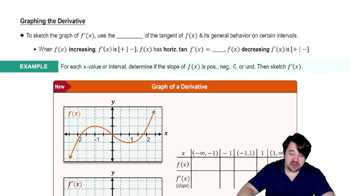
Graphing The Derivative

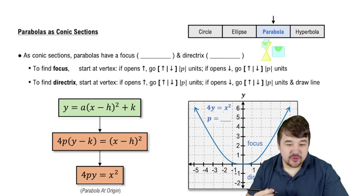
Conic Sections

Conic sections are the curves obtained by intersecting a plane with a double-napped cone. The equation given, y² - 4x² = 4, represents a hyperbola, which is characterized by its two branches that open away from each other. Understanding the properties of conic sections is essential for analyzing their graphs and symmetries.
추천 영상:
가이드 코스
5:33
Parabolas as Conic Sections

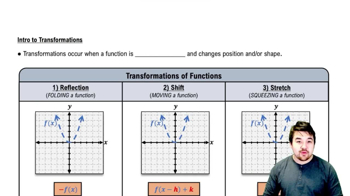
Transformations of Functions

Transformations of functions involve shifting, reflecting, stretching, or compressing the graph of a function. For example, replacing y with -y reflects the graph across the x-axis, while replacing x with -x reflects it across the y-axis. These transformations are crucial for determining the symmetry of a graph, as they can reveal how the graph behaves under various operations.
추천 영상:
가이드 코스
5:25
Intro to Transformations
관련 실천
교과서 질문

A culture of bacteria has a population of 150150 cells when it is first observed. The population doubles every 12 hr12~\(\text{hr}\), which means its population is governed by the function p(t)=150⋅2t12p\(\left\)(t\(\right\))=150\(\cdot{2^{\frac{t}{12}\)}}, where tt is the number of hours after the first observation.

What is the population 4 days4~\(\text{days}\) after the first observation?

321
views
교과서 질문

Inverse of composite functions


c. Explain why if g and h are one-to-one, the inverse of ƒ(x) = g(h(x)) exists.

319
views
교과서 질문

Inverse of composite functions


b. Let g(x) = x² + 1 and h(x) = √x. Consider the composite function ƒ(x) = g(h(x)). Find ƒ⁻¹ directly and then express it in terms of g⁻¹ and h⁻¹

302
views
교과서 질문

A culture of bacteria has a population of 150150 cells when it is first observed. The population doubles every 12 hr12~\(\text{hr}\), which means its population is governed by the function p(t)=150⋅2t12p\(\left\)(t\(\right\))=150\(\cdot{2^{\frac{t}{12}\)}}, where tt is the number of hours after the first observation.

How long does it take the population to triple in size?

285
views
교과서 질문

Splitting up curves The unit circle x² + y² = 1  consists of four one-to-one functions, ƒ₁ (x), ƒ₂(x) , ƒ₃(x), and ƒ₄ (x)  (see figure)<IMAGE>.


b. Find the inverse of each function and write it as y= ƒ⁻¹ (x)

281
views
교과서 질문

Determine whether the following statements are true and give an explanation or counterexample.


If y= 3ˣ , then x = ³√y

323
views