Ch. 1 - Functions
Briggs - Calculus: Early Transcendentals 3rd Edition
Briggs3rd EditionCalculus: Early TranscendentalsISBN: 9780136847243당신이 사용하는 게 아니라요?교과서 변경
1장, 문제 55d

Use shifts and scalings to transform the graph of ƒ(x)=x2ƒ(x)=x^2 into the graph of g. Use a graphing utility to check your work.
g(x)=6ƒ(x23)+1g(x)=6ƒ(\(\frac{x-2}{3}\))+1

검증된 단계별 안내
1
g(x) = 6ƒ\(\left\)(\(\frac{x-2}{3}\)\(\right\)) + 1 is a transformation of ƒ(x) = x^2.
Identify the inner transformation: ƒ\(\left\)(\(\frac{x-2}{3}\)\(\right\)) indicates a horizontal shift and scaling.
The expression \(\frac{x-2}{3}\) represents a horizontal shift to the right by 2 units and a horizontal scaling by a factor of 3.
The coefficient 6 outside the function ƒ indicates a vertical scaling by a factor of 6.
The +1 at the end of the expression indicates a vertical shift upwards by 1 unit.

비슷한 문제에 대한 검증된 영상 답변:

이 영상 해법은 위 문제에 도움이 된다고 튜터들이 추천한 것입니다.
영상 길이:
7m

주요 개념

질문에 올바르게 답하기 위해 반드시 이해해야 하는 핵심 개념들은 다음과 같습니다.

Transformations of Functions

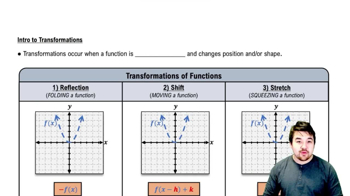
Transformations of functions involve shifting, stretching, compressing, or reflecting the graph of a function. In this context, the function ƒ(x) = x² is transformed into g(x) through a series of operations, including horizontal shifts (x - 2), vertical stretches (multiplying by 6), and vertical shifts (adding 1). Understanding these transformations is crucial for accurately modifying the graph.
추천 영상:
가이드 코스
5:25
Intro to Transformations

Horizontal and Vertical Shifts

Horizontal and vertical shifts are specific types of transformations that move the graph of a function without altering its shape. A horizontal shift occurs when the input variable x is adjusted, such as in (x - 2), which shifts the graph 2 units to the right. A vertical shift, like adding 1 to the function, moves the graph up by 1 unit. Recognizing these shifts helps in visualizing the new position of the graph.
추천 영상:
가이드 코스
5:25
Intro to Transformations

Scaling and Stretching

Scaling and stretching refer to the changes in the graph's size and shape. When a function is multiplied by a constant, such as 6 in g(x), it vertically stretches the graph, making it taller. Conversely, if a fraction is applied to the input, like dividing by 3, it horizontally stretches the graph, making it wider. These concepts are essential for understanding how the graph of g(x) relates to the original function ƒ(x).
추천 영상:
가이드 코스
5:25
Intro to Transformations