Ch. 1 - Functions
Briggs - Calculus: Early Transcendentals 3rd Edition
Briggs3rd EditionCalculus: Early TranscendentalsISBN: 9780136847243당신이 사용하는 게 아니라요?교과서 변경
1장, 문제 15a

Use the graphs of ƒ and g in the figure to determine the following function values. y = f(x) ; y=g(x) <IMAGE>


a. (ƒ o g ) (2)

검증된 단계별 안내
1
Identify the function composition (f o g)(x), which means f(g(x)).
Determine the value of g(2) by locating x = 2 on the graph of g and finding the corresponding y-value.
Use the y-value obtained from g(2) as the input for the function f.
Locate this new input on the graph of f to find the corresponding y-value, which is f(g(2)).
The y-value found in the previous step is the value of (f o g)(2).

비슷한 문제에 대한 검증된 영상 답변:

이 영상 해법은 위 문제에 도움이 된다고 튜터들이 추천한 것입니다.
영상 길이:
2m

주요 개념

질문에 올바르게 답하기 위해 반드시 이해해야 하는 핵심 개념들은 다음과 같습니다.

Function Composition

Function composition involves combining two functions, where the output of one function becomes the input of another. In this case, (ƒ o g)(2) means you first evaluate g at 2, and then use that result as the input for the function ƒ. Understanding how to perform this operation is crucial for solving the problem.
추천 영상:
3:48
Evaluate Composite Functions - Special Cases

Evaluating Functions

Evaluating functions requires substituting a specific input value into the function's formula or graph. For instance, to find g(2), you would locate the point on the graph of g where x equals 2 and determine the corresponding y-value. This step is essential for finding the correct input for the next function in the composition.
추천 영상:
가이드 코스
4:26
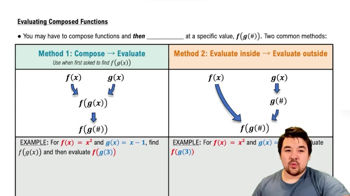
Evaluating Composed Functions

Graph Interpretation

Interpreting graphs is vital for understanding the behavior of functions visually. It involves analyzing the plotted points, slopes, and intersections to extract function values. In this question, you will need to read the graphs of ƒ and g accurately to find the necessary values for the composition.
추천 영상:
가이드 코스
06:15
Graphing The Derivative