Ch. 1 - Functions
Briggs - Calculus: Early Transcendentals 3rd Edition
Briggs3rd EditionCalculus: Early TranscendentalsISBN: 9780136847243당신이 사용하는 게 아니라요?교과서 변경
1장, 문제 16h

Use the table to evaluate the given compositions. <IMAGE>


g(ƒ(h(4)))

검증된 단계별 안내
1
Identify the innermost function in the composition, which is \( h(4) \).
Use the table to find the value of \( h(4) \).
Substitute the value of \( h(4) \) into the next function, \( f(x) \), to find \( f(h(4)) \).
Use the table to find the value of \( f(h(4)) \).
Substitute the value of \( f(h(4)) \) into the outermost function, \( g(x) \), to find \( g(f(h(4))) \).

비슷한 문제에 대한 검증된 영상 답변:

이 영상 해법은 위 문제에 도움이 된다고 튜터들이 추천한 것입니다.
영상 길이:
1m
도움이 되었나요?

주요 개념

질문에 올바르게 답하기 위해 반드시 이해해야 하는 핵심 개념들은 다음과 같습니다.

Function Composition

Function composition involves combining two or more functions to create a new function. If you have functions f(x) and g(x), the composition g(f(x)) means you first apply f to x, then apply g to the result of f. Understanding how to evaluate compositions is crucial for solving problems that involve multiple functions.
추천 영상:
3:48
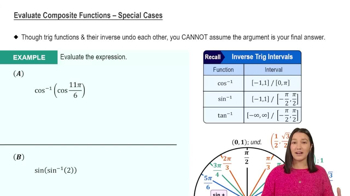
Evaluate Composite Functions - Special Cases

Evaluating Functions

Evaluating a function means substituting a specific input value into the function to find the output. For example, if f(x) = x + 2, then f(4) = 4 + 2 = 6. In the context of compositions, you must evaluate the innermost function first and use its output as the input for the next function.
추천 영상:
가이드 코스
4:26
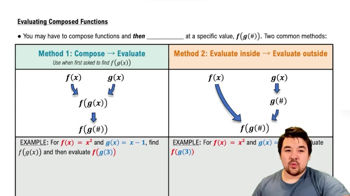
Evaluating Composed Functions

Order of Operations

The order of operations is a set of rules that dictates the sequence in which mathematical operations should be performed. In function compositions, this means evaluating from the innermost function outward. This principle is essential to ensure that you arrive at the correct final result when dealing with multiple functions.
추천 영상:
02:42
Higher Order Derivatives