Ch. 1 - Functions
Briggs - Calculus: Early Transcendentals 3rd Edition
Briggs3rd EditionCalculus: Early TranscendentalsISBN: 9780136847243당신이 사용하는 게 아니라요?교과서 변경
1장, 문제 7

What are the three Pythagorean identities for the trigonometric functions?

검증된 단계별 안내
1
The Pythagorean identities are fundamental relationships between the trigonometric functions sine, cosine, and tangent.
The first Pythagorean identity is derived from the Pythagorean theorem and states: \( \sin^2(\theta) + \cos^2(\theta) = 1 \).
The second identity is obtained by dividing the first identity by \( \cos^2(\theta) \), resulting in: \( 1 + \tan^2(\theta) = \sec^2(\theta) \).
The third identity is derived by dividing the first identity by \( \sin^2(\theta) \), leading to: \( 1 + \cot^2(\theta) = \csc^2(\theta) \).
These identities are useful for simplifying expressions and solving trigonometric equations.

비슷한 문제에 대한 검증된 영상 답변:

이 영상 해법은 위 문제에 도움이 된다고 튜터들이 추천한 것입니다.
영상 길이:
4m
도움이 되었나요?

주요 개념

질문에 올바르게 답하기 위해 반드시 이해해야 하는 핵심 개념들은 다음과 같습니다.

Pythagorean Identities

Pythagorean identities are fundamental relationships in trigonometry that relate the squares of the sine, cosine, and tangent functions. They stem from the Pythagorean theorem, which states that in a right triangle, the square of the hypotenuse equals the sum of the squares of the other two sides. These identities are essential for simplifying trigonometric expressions and solving equations.
추천 영상:
7:17
Verifying Trig Equations as Identities

Sine and Cosine Relationship

The first Pythagorean identity states that sin²(θ) + cos²(θ) = 1 for any angle θ. This identity illustrates the relationship between the sine and cosine functions, showing that the sum of their squares is always equal to one. It is crucial for understanding the unit circle and the behavior of trigonometric functions.
추천 영상:
03:53
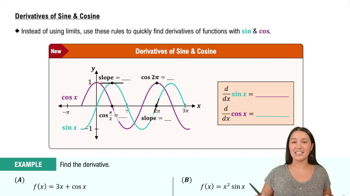
Derivatives of Sine & Cosine

Tangent and Secant Relationship

The second Pythagorean identity is 1 + tan²(θ) = sec²(θ), which connects the tangent and secant functions. This identity is derived from the first identity by dividing the sine and cosine functions. It is particularly useful in calculus for differentiating and integrating trigonometric functions, as well as in solving trigonometric equations.
추천 영상:
가이드 코스
05:13
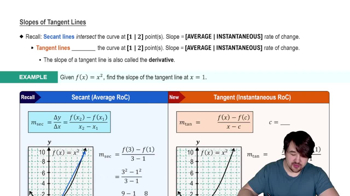
Slopes of Tangent Lines