
교과서 질문
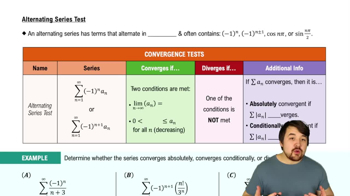
45–63. Absolute and conditional convergence Determine whether the following series converge absolutely, converge conditionally, or diverge.
∑ (k = 1 to ∞) cos(k) / k³
70
views

 검증된 단계별 안내
 10:54
10:54
 05:50
05:50 6:04
6:0445–63. Absolute and conditional convergence Determine whether the following series converge absolutely, converge conditionally, or diverge.
∑ (k = 1 to ∞) cos(k) / k³
33–38. {Use of Tech} Remainders in alternating series Determine how many terms of the following convergent series must be summed to be sure that the remainder is less than 10⁻⁴ in magnitude. Although you do not need it, the exact value of the series is given in each case.
ln 2 = ∑ (k = 1 to ∞) (−1)ᵏ⁺¹ / k
11–86. Applying convergence tests Determine whether the following series converge. Justify your answers.
∑ (from k = 1 to ∞)(1 + 1 / (2k))ᵏ
Property of divergent series Prove Property 2 of Theorem 10.8: If ∑ aₖ diverges, then ∑ caₖ also diverges, for any real number c ≠ 0.
11–86. Applying convergence tests Determine whether the following series converge. Justify your answers.
∑ (from k = 1 to ∞)(ln²k) / k³ᐟ²
What comparison series would you use with the Comparison Test to determine whether ∑ (k = 1 to ∞) 2ᵏ / (3ᵏ + 1) converges?