Ch. 10 - Sequences and Infinite Series
Briggs - Calculus: Early Transcendentals 3rd Edition
Briggs3rd EditionCalculus: Early TranscendentalsISBN: 9780136847243당신이 사용하는 게 아니라요?교과서 변경
10장, 문제 10.8.73

11–86. Applying convergence tests Determine whether the following series converge. Justify your answers.


∑ (from k = 0 to ∞)k² · 1.001⁻ᵏ

검증된 단계별 안내
1
Identify the given series: \( \sum_{k=0}^{\infty} k^{2} \cdot 1.001^{-k} \). Notice that the general term is \( a_k = k^{2} \cdot (1.001)^{-k} \).
Rewrite the term to see the exponential part clearly: \( a_k = k^{2} \cdot \left( \frac{1}{1.001} \right)^{k} \). Since \( \frac{1}{1.001} < 1 \), this suggests the terms involve a polynomial factor times an exponential decay.
Consider applying the Ratio Test, which is useful for series involving factorials, exponentials, or powers. The Ratio Test states to compute \( L = \lim_{k \to \infty} \left| \frac{a_{k+1}}{a_k} \right| \).
Calculate \( \frac{a_{k+1}}{a_k} = \frac{(k+1)^2 \cdot (1.001)^{-(k+1)}}{k^2 \cdot (1.001)^{-k}} = \frac{(k+1)^2}{k^2} \cdot \frac{1}{1.001} \).
Evaluate the limit \( L = \lim_{k \to \infty} \frac{(k+1)^2}{k^2} \cdot \frac{1}{1.001} = \left( \lim_{k \to \infty} \frac{(k+1)^2}{k^2} \right) \cdot \frac{1}{1.001} = 1 \cdot \frac{1}{1.001} < 1 \). Since \( L < 1 \), the Ratio Test confirms that the series converges.

비슷한 문제에 대한 검증된 영상 답변:

이 영상 해법은 위 문제에 도움이 된다고 튜터들이 추천한 것입니다.
영상 길이:
2m
도움이 되었나요?

주요 개념

질문에 올바르게 답하기 위해 반드시 이해해야 하는 핵심 개념들은 다음과 같습니다.

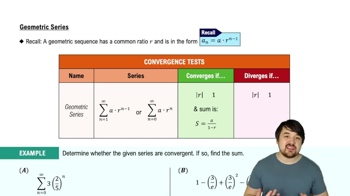
Geometric Series and Its Convergence

A geometric series has terms of the form ar^k, where r is the common ratio. It converges if |r| < 1 and diverges otherwise. Understanding this helps analyze series with exponential terms like 1.001⁻ᵏ, which can be rewritten as (1/1.001)^k, a geometric term with ratio less than 1.
추천 영상:
가이드 코스
06:00
Geometric Series

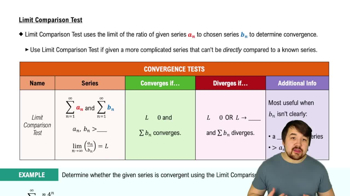
Comparison and Limit Comparison Tests

These tests compare a given series to a known benchmark series to determine convergence. The limit comparison test is useful when terms involve polynomials and exponentials, helping to confirm if the series behaves like a convergent geometric series despite polynomial factors like k².
추천 영상:
가이드 코스
07:45
Limit Comparison Test

Effect of Polynomial Factors on Series Convergence

Polynomial terms like k² grow slower than exponential decay terms. When combined with a geometric term with ratio less than 1, the exponential decay dominates, often ensuring convergence. Recognizing this balance is key to justifying convergence in series with mixed polynomial and exponential terms.
추천 영상:
08:26
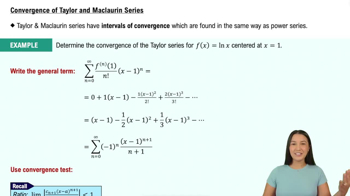
Convergence of Taylor & Maclaurin Series