The terms of a sequence of partial sums are defined by Sₙ = ∑ⁿₖ₌₁ k² , for n=1, 2, 3, .....Evaluate the first four terms of the sequence.
Ch. 10 - Sequences and Infinite Series
10장, 문제 10.8.67
11–86. Applying convergence tests Determine whether the following series converge. Justify your answers.
∑ (from j = 1 to ∞)cot(–1 / j) / 2ʲ
검증된 단계별 안내1
Rewrite the general term of the series to better understand its behavior: the series is \( \sum_{j=1}^\infty \frac{\cot\left(-\frac{1}{j}\right)}{2^j} \). Note that \( 2^j \) grows exponentially, which suggests the denominator grows quickly.
Use the odd function property of cotangent: since \( \cot(-x) = -\cot(x) \), rewrite the term as \( \frac{-\cot\left(\frac{1}{j}\right)}{2^j} = -\frac{\cot\left(\frac{1}{j}\right)}{2^j} \). This helps simplify the analysis.
Analyze the behavior of \( \cot\left(\frac{1}{j}\right) \) as \( j \to \infty \). Since \( \frac{1}{j} \to 0 \), use the approximation \( \cot x \approx \frac{1}{x} \) for small \( x \). Thus, \( \cot\left(\frac{1}{j}\right) \approx j \).
Substitute the approximation into the term: \( -\frac{\cot\left(\frac{1}{j}\right)}{2^j} \approx -\frac{j}{2^j} \). Now consider the series \( \sum_{j=1}^\infty -\frac{j}{2^j} \).
Apply the Ratio Test or Root Test to the series \( \sum \frac{j}{2^j} \) to determine convergence. Since \( 2^j \) grows faster than any polynomial \( j \), the series converges absolutely, and thus the original series converges.

비슷한 문제에 대한 검증된 영상 답변:
이 영상 해법은 위 문제에 도움이 된다고 튜터들이 추천한 것입니다.
영상 길이:
3m도움이 되었나요?
주요 개념
질문에 올바르게 답하기 위해 반드시 이해해야 하는 핵심 개념들은 다음과 같습니다.
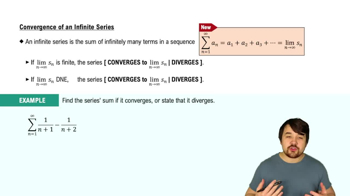
Convergence of Infinite Series
An infinite series converges if the sequence of its partial sums approaches a finite limit. Understanding convergence is essential to determine whether the sum of infinitely many terms results in a finite value or diverges to infinity or oscillates.
추천 영상:
가이드 코스
Convergence of an Infinite Series
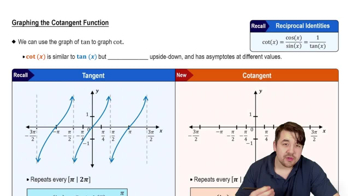
Behavior and Approximation of Functions for Small Arguments
Analyzing the behavior of functions like cotangent near zero helps simplify terms in a series. For small x, cot(x) can be approximated using series expansions, which aids in understanding the general term's behavior and applying convergence tests effectively.
추천 영상:
가이드 코스
Introduction to Cotangent Graph
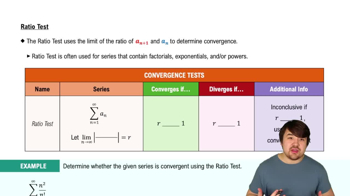
Convergence Tests for Series (Comparison and Ratio Tests)
Tests such as the Ratio Test and Comparison Test help determine series convergence by comparing terms to known convergent series or analyzing the limit of term ratios. These tests are crucial for series involving complex terms like cot(–1/j)/2^j.
추천 영상:
가이드 코스
Ratio Test
관련 실천
교과서 질문
72
views
교과서 질문
11–86. Applying convergence tests Determine whether the following series converge. Justify your answers.
∑ (from k = 1 to ∞)sin(1 / k⁹)
46
views
교과서 질문
46–53. Decimal expansions
Write each repeating decimal first as a geometric series and then as a fraction (a ratio of two integers).
51.0.456̅ = 0.456456456…
67
views
교과서 질문
13–52. Limits of sequences
Find the limit of the following sequences or determine that the sequence diverges.
{(3n³ − 1)⁄(2n³ + 1)}
34
views
교과서 질문
11–86. Applying convergence tests Determine whether the following series converge. Justify your answers.
∑ (from k = 1 to ∞) 1 / (√k × e^(√k))
48
views
교과서 질문
32–49. Choose your test Use the test of your choice to determine whether the following series converge absolutely, converge conditionally, or diverge.
∑ (from k = 1 to ∞) (√k / k − 1)²ᵏ
41
views