Ch. 10 - Sequences and Infinite Series
Briggs - Calculus: Early Transcendentals 3rd Edition
Briggs3rd EditionCalculus: Early TranscendentalsISBN: 9780136847243당신이 사용하는 게 아니라요?교과서 변경
10장, 문제 10.8.61

11–86. Applying convergence tests Determine whether the following series converge. Justify your answers.


∑ (from k = 1 to ∞)1 / ln(eᵏ + 1)

검증된 단계별 안내
1
First, write down the general term of the series: \(a_k = \frac{1}{\ln(e^k + 1)}\).
Simplify the expression inside the logarithm for large \(k\). Since \(e^k\) grows very fast, \(e^k + 1 \approx e^k\), so \(\ln(e^k + 1) \approx \ln(e^k) = k\).
Using this approximation, the general term behaves like \(a_k \approx \frac{1}{k}\) for large \(k\).
Recall that the harmonic series \(\sum \frac{1}{k}\) diverges, so by the Comparison Test or Limit Comparison Test, compare \(a_k\) with \(\frac{1}{k}\) to determine convergence.
Calculate the limit \(\lim_{k \to \infty} \frac{a_k}{1/k}\) to apply the Limit Comparison Test and conclude whether the original series converges or diverges.

비슷한 문제에 대한 검증된 영상 답변:

이 영상 해법은 위 문제에 도움이 된다고 튜터들이 추천한 것입니다.
영상 길이:
3m
도움이 되었나요?

주요 개념

질문에 올바르게 답하기 위해 반드시 이해해야 하는 핵심 개념들은 다음과 같습니다.

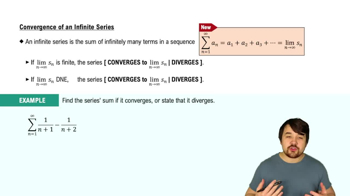
Convergence of Infinite Series

An infinite series converges if the sequence of its partial sums approaches a finite limit. Determining convergence involves analyzing the behavior of the terms and applying appropriate tests to see if the sum settles to a finite value or diverges.
추천 영상:
가이드 코스
06:52
Convergence of an Infinite Series

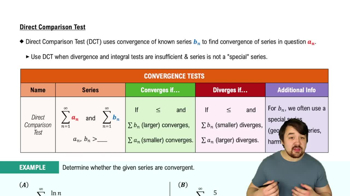
Comparison Test

The Comparison Test involves comparing the given series to a known benchmark series. If the terms of the given series are smaller than those of a convergent series, it converges; if larger than those of a divergent series, it diverges. This test helps in establishing convergence by bounding.
추천 영상:
가이드 코스
09:25
Direct Comparison Test

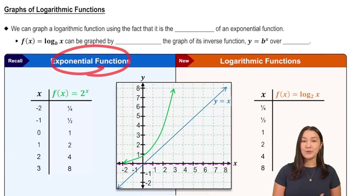
Behavior of Logarithmic Functions in Series

Understanding how logarithmic functions grow is crucial when they appear in series terms. Since ln(e^k + 1) behaves roughly like k for large k, the terms 1/ln(e^k + 1) behave like 1/k, which is a harmonic-type term influencing convergence analysis.
추천 영상:
5:26
Graphs of Logarithmic Functions