Finding steady states using infinite series Solve Exercise 40 by expressing the amount of aspirin in your blood as a geometric series and evaluating the series.
Ch. 10 - Sequences and Infinite Series
10장, 문제 10.R.15
12–24. Limits of sequences Evaluate the limit of the sequence or state that it does not exist.
aₙ = (2ⁿ + 5ⁿ⁺¹) / 5ⁿ
검증된 단계별 안내1
Identify the given sequence: \(a_n = \frac{2^n + 5^{n+1}}{5^n}\).
Rewrite the sequence by separating the terms in the numerator over the denominator: \(a_n = \frac{2^n}{5^n} + \frac{5^{n+1}}{5^n}\).
Simplify each term: \(\frac{2^n}{5^n} = \left(\frac{2}{5}\right)^n\) and \(\frac{5^{n+1}}{5^n} = 5^{(n+1)-n} = 5\).
Express the sequence as \(a_n = \left(\frac{2}{5}\right)^n + 5\).
Analyze the limit as \(n\) approaches infinity: since \(\left(\frac{2}{5}\right)^n\) tends to 0 (because \(\frac{2}{5} < 1\)), the limit of \(a_n\) is the limit of \(0 + 5\), which is 5.

비슷한 문제에 대한 검증된 영상 답변:
이 영상 해법은 위 문제에 도움이 된다고 튜터들이 추천한 것입니다.
영상 길이:
2m도움이 되었나요?
주요 개념
질문에 올바르게 답하기 위해 반드시 이해해야 하는 핵심 개념들은 다음과 같습니다.
Limits of Sequences
The limit of a sequence describes the value that the terms of the sequence approach as the index n becomes very large. If the terms get arbitrarily close to a specific number, the sequence converges to that limit; otherwise, it diverges.
추천 영상:
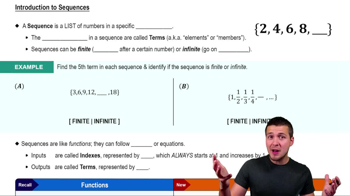
Introduction to Sequences
Properties of Exponential Functions
Exponential functions with different bases grow at different rates. When comparing terms like 2ⁿ and 5ⁿ, the term with the larger base dominates as n increases, which helps simplify the limit by focusing on the dominant term.
추천 영상:
가이드 코스
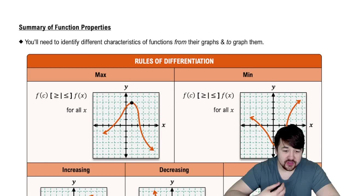
Properties of Functions
Algebraic Manipulation of Sequences
Simplifying sequences often involves factoring and dividing numerator and denominator by the highest power term to reveal dominant behavior. This technique helps in evaluating limits by reducing complex expressions to simpler forms.
추천 영상:
Introduction to Sequences
관련 실천
교과서 질문
53
views
교과서 질문
12–24. Limits of sequences Evaluate the limit of the sequence or state that it does not exist.
aₙ = (–1)ⁿ / 0.9ⁿ
48
views
교과서 질문
Geometric sums
Evaluate the geometric sums
∑ (from k = 0 to 9) (0.2)ᵏand∑ (from k = 2 to 9) (0.2)ᵏ.
50
views
교과서 질문
Explain why or why not
Determine whether the following statements are true and give an explanation or counterexample.
a.The terms of the sequence {aₙ} increase in magnitude, so the limit of the sequence does not exist.
43
views
교과서 질문
b.Does the series ∑ (from k = 1 to ∞) k/(k + 1) converge? Why or why not?
86
views
교과서 질문
Estimate the value of the series ∑ (from k = 1 to ∞)1 / (2k + 5)³ to within 10⁻⁴ of its exact value.
43
views