Ch. 10 - Sequences and Infinite Series
Briggs - Calculus: Early Transcendentals 3rd Edition
Briggs3rd EditionCalculus: Early TranscendentalsISBN: 9780136847243당신이 사용하는 게 아니라요?교과서 변경
10장, 문제 10.1.33c

27–34. Working with sequences Several terms of a sequence {aₙ}ₙ₌₁∞ are given.
c. Find an explicit formula for the nth term of the sequence.


{-5, 5, -5, 5, ......}

검증된 단계별 안내
1
Identify the pattern in the given sequence: {-5, 5, -5, 5, ...}. Notice that the terms alternate between -5 and 5.
Recognize that this is an alternating sequence where the sign changes every term, but the absolute value remains constant at 5.
Recall that an alternating sign can be represented using powers of -1, specifically \((-1)^n\) or \((-1)^{n+1}\), which alternate between -1 and 1 as n increases.
Choose the appropriate power of -1 to match the first term: since the first term is -5 when n=1, test \((-1)^n\) and \((-1)^{n+1}\) to see which one gives -1 at n=1.
Write the explicit formula for the nth term as \(a_n = 5 \times (-1)^n\) or \(a_n = 5 \times (-1)^{n+1}\), depending on which matches the initial term, ensuring the sign alternates correctly.

비슷한 문제에 대한 검증된 영상 답변:

이 영상 해법은 위 문제에 도움이 된다고 튜터들이 추천한 것입니다.
영상 길이:
1m
도움이 되었나요?

주요 개념

질문에 올바르게 답하기 위해 반드시 이해해야 하는 핵심 개념들은 다음과 같습니다.

Sequences and Terms

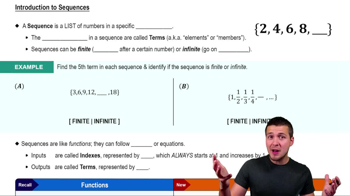
A sequence is an ordered list of numbers defined by a specific pattern or rule. Each number in the sequence is called a term, denoted as aₙ, where n indicates the term's position. Understanding how terms change helps in identifying the sequence's behavior and formulating its general term.
추천 영상:
8:22
Introduction to Sequences

Explicit Formula for a Sequence

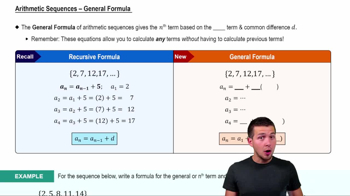
An explicit formula expresses the nth term of a sequence directly in terms of n, without needing previous terms. It allows calculation of any term independently. Finding this formula involves recognizing patterns such as arithmetic, geometric, or alternating signs in the sequence.
추천 영상:
5:17
Arithmetic Sequences - General Formula

Alternating Sequences and Sign Patterns

Alternating sequences switch signs between terms, often modeled using powers of -1. For example, (-1)ⁿ or (-1)ⁿ⁺¹ generates alternating positive and negative values. Identifying this pattern is key to writing an explicit formula for sequences like {-5, 5, -5, 5, ...}.
추천 영상:
8:22
Introduction to Sequences
관련 실천
교과서 질문

{Use of Tech} A savings plan

James begins a savings plan in which he deposits \(100 at the beginning of each month into an account that earns 9% interest annually, or equivalently, 0.75% per month.

To be clear, on the first day of each month, the bank adds 0.75% of the current balance as interest, and then James deposits \)100.


Let Bₙ be the balance in the account after the nᵗʰ payment, where B₀ = \(0.


c.How many months are needed to reach a balance of \)5000?

43
views
교과서 질문

Explain why or why not

Determine whether the following statements are true and give an explanation or counterexample.


c.The convergent sequences {aₙ} and {bₙ} differ in their first 100 terms, but aₙ = bₙ for n > 100.

It follows that limₙ→∞aₙ = limₙ→∞bₙ.

58
views
교과서 질문

{Use of Tech} Periodic dosing

Many people take aspirin on a regular basis as a preventive measure for heart disease. Suppose a person takes 80 mg of aspirin every 24 hours. Assume aspirin has a half-life of 24 hours; that is, every 24 hours, half of the drug in the blood is eliminated.


c.Assuming the sequence has a limit, confirm the result of part (b) by finding the limit of {dₙ} directly.

44
views
교과서 질문

39–40. {Use of Tech} Lower and upper bounds of a series

For each convergent series and given value of n, use Theorem 10.13 to complete the following.


c. Find lower and upper bounds (Lₙ and Uₙ, respectively) for the exact value of the series.


39. ∑ (k = 1 to ∞) 1 / k⁷ ; n = 2

89
views
교과서 질문

Explain why or why not

Determine whether the following statements are true and give an explanation or counterexample.


c.If the terms of the sequence {aₙ} are positive and increasing, then the sequence of partial sums for the series∑⁽∞⁾ₖ₌₁aₖ diverges.

42
views
교과서 질문

27–34. Working with sequences Several terms of a sequence {aₙ}ₙ₌₁∞ are given.

c. Find an explicit formula for the nth term of the sequence.


{1, 3, 9, 27, 81, ......}

60
views