
교과서 질문
Finding steady states using infinite series Solve Exercise 40 by expressing the amount of aspirin in your blood as a geometric series and evaluating the series.
53
views

 검증된 단계별 안내
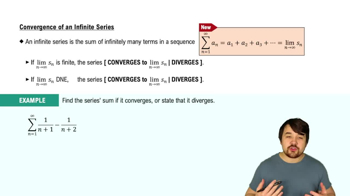
 06:52
06:52
 05:36
05:36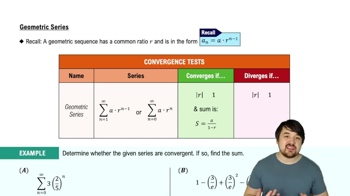 06:00
06:00Finding steady states using infinite series Solve Exercise 40 by expressing the amount of aspirin in your blood as a geometric series and evaluating the series.
12–24. Limits of sequences Evaluate the limit of the sequence or state that it does not exist.
aₙ = (–1)ⁿ / 0.9ⁿ
25–26. Recursively defined sequences
The following sequences {aₙ} from n = 0 to ∞ are defined by a recurrence relation. Assume each sequence is monotonic and bounded.
b.Determine the limit of each sequence.
25.aₙ₊₁ = (1 / 2) aₙ + 8;a₀ = 80
Geometric sums
Evaluate the geometric sums
∑ (from k = 0 to 9) (0.2)ᵏand∑ (from k = 2 to 9) (0.2)ᵏ.
Explain why or why not
Determine whether the following statements are true and give an explanation or counterexample.
a.The terms of the sequence {aₙ} increase in magnitude, so the limit of the sequence does not exist.
Estimate the value of the series ∑ (from k = 1 to ∞)1 / (2k + 5)³ to within 10⁻⁴ of its exact value.