
Ch. 10 - Sequences and Infinite Series
Briggs - Calculus: Early Transcendentals 3rd Edition
Briggs3rd EditionCalculus: Early TranscendentalsISBN: 9780136847243당신이 사용하는 게 아니라요?교과서 변경
10장, 문제 10.4.43c

41–44. {Use of Tech} Remainders and estimates Consider the following convergent series.


c. Find lower and upper bounds (Lₙ and Uₙ, respectively) on the exact value of the series.


43. ∑ (k = 1 to ∞) 1 / 3ᵏ

검증된 단계별 안내
1
Recognize that the series given is a geometric series of the form \(\sum_{k=1}^{\infty} \frac{1}{3^k}\), where the first term \(a = \frac{1}{3}\) and the common ratio \(r = \frac{1}{3}\).
Recall the formula for the sum of an infinite geometric series when \(|r| < 1\): \(S = \frac{a}{1 - r}\). This gives the exact sum of the series.
To find the lower and upper bounds \(L_n\) and \(U_n\) for the partial sum \(S_n = \sum_{k=1}^n \frac{1}{3^k}\), calculate the partial sum using the finite geometric series formula: \(S_n = a \frac{1 - r^n}{1 - r}\).
Understand that the remainder (or error) after \(n\) terms, \(R_n = S - S_n\), can be expressed as \(R_n = \frac{a r^n}{1 - r}\). This remainder helps in estimating how close \(S_n\) is to the exact sum \(S\).
Use the partial sum \(S_n\) and the remainder \(R_n\) to establish the bounds: the lower bound \(L_n = S_n\) and the upper bound \(U_n = S_n + R_n\). This means the exact sum \(S\) lies between \(L_n\) and \(U_n\).

비슷한 문제에 대한 검증된 영상 답변:

이 영상 해법은 위 문제에 도움이 된다고 튜터들이 추천한 것입니다.
영상 길이:
5m

주요 개념

질문에 올바르게 답하기 위해 반드시 이해해야 하는 핵심 개념들은 다음과 같습니다.

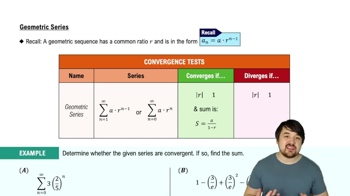
Geometric Series

A geometric series is a sum of terms where each term is found by multiplying the previous term by a constant ratio. For |r| < 1, the infinite geometric series converges to a finite sum S = a / (1 - r), where a is the first term. Understanding this helps evaluate the exact sum of series like ∑ 1/3^k.
추천 영상:
가이드 코스
06:00
Geometric Series

Partial Sums and Remainders

Partial sums are the sums of the first n terms of a series, providing an approximation to the infinite sum. The remainder (or tail) is the difference between the infinite sum and the partial sum. Estimating remainders helps find bounds on the exact value of the series.
추천 영상:
가이드 코스
08:01
Integration Using Partial Fractions

Bounds on Series Sums

For convergent series, the exact sum lies between the partial sum and the partial sum plus the remainder estimate. Using remainder estimates, one can find lower and upper bounds (Lₙ and Uₙ) to bracket the true sum, ensuring an accurate approximation within a known error margin.
추천 영상:
가이드 코스
06:45
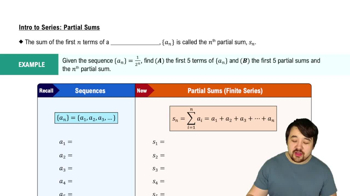
Intro to Series: Partial Sums
관련 실천
교과서 질문

72–75. {Use of Tech} Practical sequences

Consider the following situations that generate a sequence


d.Using a calculator or a graphing utility, estimate the limit of the sequence or state that it does not exist.


Drug elimination

Jack took a 200-mg dose of a pain killer at midnight. Every hour, 5% of the drug is washed out of his bloodstream. Let dₙ be the amount of drug in Jack’s blood n hours after the drug was taken, where d₀ = 200mg.

35
views
교과서 질문

67–70. Formulas for sequences of partial sums Consider the following infinite series.


c.Make a conjecture for the value of the series.


∑⁽∞⁾ₖ₌₁2⁄[(2k − 1)(2k + 1)]

92
views
교과서 질문

Explain why or why not Determine whether the following statements are true and give an explanation or counterexample.


c. If lim (as k → ∞) ᵏ√|aₖ| = 1/4, then ∑ 10aₖ converges absolutely.

61
views
교과서 질문

72–75. {Use of Tech} Practical sequences

Consider the following situations that generate a sequence


d.Using a calculator or a graphing utility, estimate the limit of the sequence or state that it does not exist.


Radioactive decay

A material transmutes 50% of its mass to another element every 10 years due to radioactive decay. Let Mₙ be the mass of the radioactive material at the end of the nᵗʰ decade, where the initial mass of the material is M₀ = 20g.

58
views
교과서 질문

Explain why or why not Determine whether the following statements are true and give an explanation or counterexample.


c. Suppose f is a continuous, positive, decreasing function, for x ≥ 1, and aₖ = f(k), for k = 1, 2, 3, …. If ∑ (k = 1 to ∞) aₖ converges to L, then ∫ (1 to ∞) f(x) dx converges to L.

63
views
교과서 질문

Explain why or why not Determine whether the following statements are true and give an explanation or counterexample.

d. If ∑ aₖ diverges, then ∑ |aₖ| diverges.

40
views