
교과서 질문
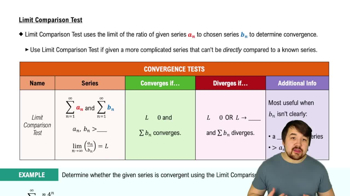
42–76. Convergence or divergence Use a convergence test of your choice to determine whether the following series converge.
∑ (from k = 1 to ∞)tanh(k)
76
views

 검증된 단계별 안내
 06:52
06:52
 07:45
07:45 06:45
06:4542–76. Convergence or divergence Use a convergence test of your choice to determine whether the following series converge.
∑ (from k = 1 to ∞)tanh(k)
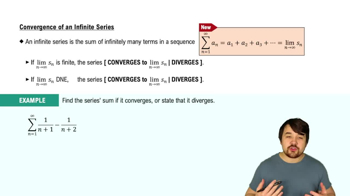
27–37. Evaluating series Evaluate the following infinite series or state that the series diverges.
∑ (from k = 1 to ∞)2ᵏ / 3ᵏ⁺²
Building a tunnel — first scenario
A crew of workers is constructing a tunnel through a mountain. Understandably, the rate of construction decreases because rocks and earth must be removed a greater distance as the tunnel gets longer. Suppose each week the crew digs 0.95 of the distance it dug the previous week. In the first week, the crew constructed 100 m of tunnel.
a.How far does the crew dig in 10 weeks? 20 weeks? N weeks?
Determine whether the following statements are true and give an explanation or counterexample.
c. The terms of the sequence of partial sums of the series ∑ aₖ approach 5/2, so the infinite series converges to 5/2.
77–87. Absolute or conditional convergence
Determine whether the following series converge absolutely, converge conditionally, or diverge.
∑ (from k = 1 to ∞)(−1)ᵏ⁺¹ / k³⁄⁷
42–76. Convergence or divergence Use a convergence test of your choice to determine whether the following series converge.
∑ (from j = 0 to ∞)2 ⋅ 4ʲ / (2j + 1)!