Ch. 10 - Sequences and Infinite Series
Briggs - Calculus: Early Transcendentals 3rd Edition
Briggs3rd EditionCalculus: Early TranscendentalsISBN: 9780136847243당신이 사용하는 게 아니라요?교과서 변경
10장, 문제 10.6.45

45–63. Absolute and conditional convergence Determine whether the following series converge absolutely, converge conditionally, or diverge.
∑ (k = 1 to ∞) (−1)ᵏ / k^(2/3)

검증된 단계별 안내
1
Identify the given series: \( \sum_{k=1}^{\infty} \frac{(-1)^k}{k^{2/3}} \). This is an alternating series because of the factor \( (-1)^k \), which alternates the sign of each term.
Check for absolute convergence by considering the series of absolute values: \( \sum_{k=1}^{\infty} \left| \frac{(-1)^k}{k^{2/3}} \right| = \sum_{k=1}^{\infty} \frac{1}{k^{2/3}} \).
Determine if the series \( \sum_{k=1}^{\infty} \frac{1}{k^{2/3}} \) converges. This is a p-series with \( p = \frac{2}{3} \). Recall that a p-series \( \sum \frac{1}{k^p} \) converges if and only if \( p > 1 \). Since \( \frac{2}{3} < 1 \), this series diverges.
Since the series does not converge absolutely, check for conditional convergence by applying the Alternating Series Test. The test requires that the terms \( b_k = \frac{1}{k^{2/3}} \) are positive, decreasing, and approach zero as \( k \to \infty \).
Verify that \( b_k = \frac{1}{k^{2/3}} \) is positive, decreasing, and \( \lim_{k \to \infty} b_k = 0 \). Since these conditions hold, the original alternating series converges conditionally by the Alternating Series Test.

비슷한 문제에 대한 검증된 영상 답변:

이 영상 해법은 위 문제에 도움이 된다고 튜터들이 추천한 것입니다.
영상 길이:
4m
도움이 되었나요?

주요 개념

질문에 올바르게 답하기 위해 반드시 이해해야 하는 핵심 개념들은 다음과 같습니다.

Absolute Convergence

A series ∑a_k converges absolutely if the series of absolute values ∑|a_k| converges. Absolute convergence guarantees convergence regardless of the sign of terms, and it implies the original series converges. Testing absolute convergence often involves comparison or p-series tests.
추천 영상:
07:51
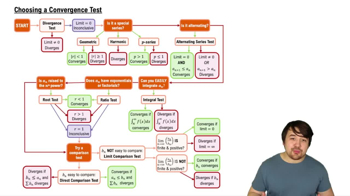
Choosing a Convergence Test

Conditional Convergence

A series converges conditionally if it converges, but does not converge absolutely. This means the series ∑a_k converges, but ∑|a_k| diverges. Alternating series with terms decreasing to zero often exhibit conditional convergence, which requires careful analysis using tests like the Alternating Series Test.
추천 영상:
07:51
Choosing a Convergence Test

p-Series and Convergence Tests

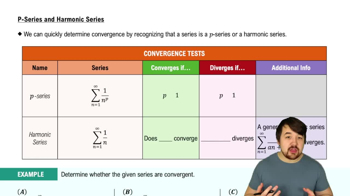
A p-series ∑1/k^p converges if p > 1 and diverges otherwise. For the given series, the exponent 2/3 < 1, so the corresponding positive term series diverges. This fact helps determine absolute convergence and guides the use of the Alternating Series Test for conditional convergence.
추천 영상:
04:30
P-Series and Harmonic Series