
Ch. 10 - Sequences and Infinite Series
Briggs - Calculus: Early Transcendentals 3rd Edition
Briggs3rd EditionCalculus: Early TranscendentalsISBN: 9780136847243당신이 사용하는 게 아니라요?교과서 변경
10장, 문제 10.2.65

55–70. More sequences
Find the limit of the following sequences or determine that the sequence diverges.


{cosn / n}

검증된 단계별 안내
1
Identify the given sequence as \( a_n = \frac{\cos n}{n} \), where \( n \) is a positive integer.
Recall that \( \cos n \) oscillates between -1 and 1 for all integer values of \( n \), so the numerator is bounded.
Note that the denominator \( n \) increases without bound as \( n \to \infty \).
Use the Squeeze Theorem by bounding the sequence: since \( -1 \leq \cos n \leq 1 \), we have \( -\frac{1}{n} \leq \frac{\cos n}{n} \leq \frac{1}{n} \).
Since both \( -\frac{1}{n} \) and \( \frac{1}{n} \) approach 0 as \( n \to \infty \), conclude that \( \lim_{n \to \infty} \frac{\cos n}{n} = 0 \).

비슷한 문제에 대한 검증된 영상 답변:

이 영상 해법은 위 문제에 도움이 된다고 튜터들이 추천한 것입니다.
영상 길이:
1m

주요 개념

질문에 올바르게 답하기 위해 반드시 이해해야 하는 핵심 개념들은 다음과 같습니다.

Limit of a Sequence

The limit of a sequence is the value that the terms of the sequence approach as the index n goes to infinity. If the terms get arbitrarily close to a specific number, the sequence converges to that limit; otherwise, it diverges.
추천 영상:
8:22
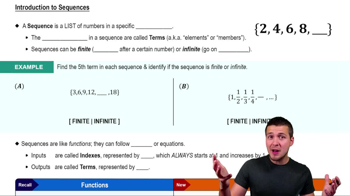
Introduction to Sequences

Behavior of the Cosine Function

The cosine function oscillates between -1 and 1 for all real numbers n. Since cos(n) does not approach a single value as n increases, it is important to consider how this oscillation affects the sequence when combined with other terms.
추천 영상:
가이드 코스
5:53
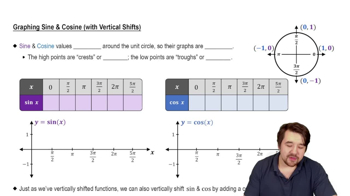
Graph of Sine and Cosine Function

Squeeze Theorem for Sequences

The Squeeze Theorem states that if a sequence is bounded above and below by two sequences that both converge to the same limit, then the original sequence also converges to that limit. This is useful when dealing with sequences involving bounded oscillating functions divided by terms that grow without bound.
추천 영상:
8:22
Introduction to Sequences
관련 실천
교과서 질문

54–69. Telescoping series

For the following telescoping series, find a formula for the nth term of the sequence of partial sums {Sₙ}. Then evaluate limₙ→∞ Sₙ to obtain the value of the series or state that the series diverges.


59. ∑ (k = –3 to ∞) 4 / ((4k – 3)(4k + 1))

119
views
교과서 질문

33–38. {Use of Tech} Remainders in alternating series Determine how many terms of the following convergent series must be summed to be sure that the remainder is less than 10⁻⁴ in magnitude. Although you do not need it, the exact value of the series is given in each case.


ln 2 = ∑ (k = 1 to ∞) (−1)ᵏ⁺¹ / k

70
views
교과서 질문

11–86. Applying convergence tests Determine whether the following series converge. Justify your answers.


∑ (from k = 1 to ∞)(1 + 1 / (2k))ᵏ

42
views
교과서 질문

51–56. {Use of Tech} Recurrence relations Consider the following recurrence relations. Make a table with at least ten terms and determine a plausible limit of the sequence or state that the sequence diverges.


aₙ₊₁ = 4aₙ + 1 a₀ = 1

57
views
교과서 질문

84–87. {Use of Tech} Sequences by recurrence relations

The following sequences, defined by a recurrence relation, are monotonic and bounded, and therefore converge by Theorem 10.5.


a.Examine the first three terms of the sequence to determine whether the sequence is nondecreasing or nonincreasing.

b.Use analytical methods to find the limit of the sequence.


aₙ₊₁ = 2aₙ(1 − aₙ);a₀ = 0.3

76
views
교과서 질문

11–86. Applying convergence tests Determine whether the following series converge. Justify your answers.

∑ (from k = 1 to ∞) 2ᵏ / (3ᵏ − 2ᵏ)

66
views