Ch. 10 - Sequences and Infinite Series
Briggs - Calculus: Early Transcendentals 3rd Edition
Briggs3rd EditionCalculus: Early TranscendentalsISBN: 9780136847243당신이 사용하는 게 아니라요?교과서 변경
10장, 문제 10.2.57

55–70. More sequences
Find the limit of the following sequences or determine that the sequence diverges.


aₙ = (−1)ⁿ ⁿ√n

검증된 단계별 안내
1
Identify the given sequence: \(a_n = (-1)^n \sqrt{n}\), where \(\sqrt{n}\) denotes the square root of \(n\).
Recall that the term \((-1)^n\) causes the sequence to alternate signs between positive and negative values as \(n\) increases.
Analyze the behavior of the magnitude of the terms, which is \(\sqrt{n}\). As \(n\) approaches infinity, \(\sqrt{n}\) grows without bound (it increases without limit).
Consider the combined effect: since the magnitude \(\sqrt{n}\) grows larger and the sign alternates, the terms will oscillate between increasingly large positive and negative values.
Conclude that because the terms do not approach a single finite value, the sequence \(a_n\) does not converge and therefore diverges.

비슷한 문제에 대한 검증된 영상 답변:

이 영상 해법은 위 문제에 도움이 된다고 튜터들이 추천한 것입니다.
영상 길이:
5m

주요 개념

질문에 올바르게 답하기 위해 반드시 이해해야 하는 핵심 개념들은 다음과 같습니다.

Limits of Sequences

The limit of a sequence describes the value that the terms of the sequence approach as the index n goes to infinity. If the terms get arbitrarily close to a specific number, the sequence converges; otherwise, it diverges. Understanding limits is essential to analyze the behavior of sequences like aₙ = (−1)ⁿ n^(1/n).
추천 영상:
8:22
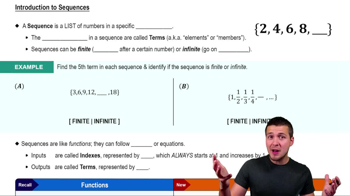
Introduction to Sequences

Nth Root and Its Limit

The nth root of n, expressed as n^(1/n), approaches 1 as n becomes very large. This is because the growth of n is tempered by the root, which grows slower, causing the expression to stabilize near 1. Recognizing this helps simplify the sequence's behavior.
추천 영상:

Alternating Sequences

Sequences with terms multiplied by (−1)ⁿ alternate in sign between positive and negative values. This oscillation can affect convergence, as the sequence may not settle on a single value. Analyzing the impact of the alternating factor is crucial to determine if the sequence converges or diverges.
추천 영상:
8:22
Introduction to Sequences