Ch. 10 - Sequences and Infinite Series
Briggs - Calculus: Early Transcendentals 3rd Edition
Briggs3rd EditionCalculus: Early TranscendentalsISBN: 9780136847243당신이 사용하는 게 아니라요?교과서 변경
10장, 문제 10.3.71b

71. Evaluating an infinite series two ways
Evaluate the series
∑ (k = 1 to ∞) (4 / 3ᵏ – 4 / 3ᵏ⁺¹) two ways.


b. Use a geometric series argument with Theorem 10.8.

검증된 단계별 안내
1
First, rewrite the given series to clearly see its terms: \( \sum_{k=1}^{\infty} \left( \frac{4}{3^k} - \frac{4}{3^{k+1}} \right) \). Notice that each term is a difference of two fractions involving powers of 3.
Next, separate the series into two separate sums: \( \sum_{k=1}^{\infty} \frac{4}{3^k} - \sum_{k=1}^{\infty} \frac{4}{3^{k+1}} \). This will help us analyze each sum individually.
Recognize that both sums are geometric series. The first sum has the first term \( a_1 = \frac{4}{3} \) and common ratio \( r = \frac{1}{3} \). The second sum starts from \( k=1 \) but with terms \( \frac{4}{3^{k+1}} \), which can be rewritten as \( \frac{4}{3} \cdot \left( \frac{1}{3} \right)^k \).
Apply the formula for the sum of an infinite geometric series, which is \( S = \frac{a_1}{1 - r} \), to both sums separately. For the first sum, use \( a_1 = \frac{4}{3} \) and \( r = \frac{1}{3} \). For the second sum, identify the first term and ratio accordingly and apply the formula.
Finally, subtract the sum of the second series from the sum of the first series to find the value of the original series. This step uses the linearity of summation and the geometric series sums derived.

비슷한 문제에 대한 검증된 영상 답변:

이 영상 해법은 위 문제에 도움이 된다고 튜터들이 추천한 것입니다.
영상 길이:
4m
도움이 되었나요?

주요 개념

질문에 올바르게 답하기 위해 반드시 이해해야 하는 핵심 개념들은 다음과 같습니다.

Infinite Series and Convergence

An infinite series is the sum of infinitely many terms. To evaluate such a series, it is crucial to determine whether it converges to a finite value. Convergence depends on the behavior of the terms as the index approaches infinity, and only convergent series have meaningful sums.
추천 영상:
가이드 코스
06:52
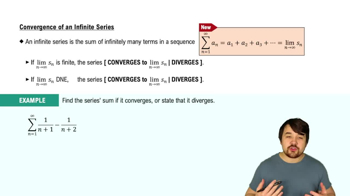
Convergence of an Infinite Series

Geometric Series and Its Sum Formula

A geometric series is a series where each term is a constant multiple (common ratio) of the previous term. The sum of an infinite geometric series with |r| < 1 is given by S = a / (1 - r), where a is the first term. This formula allows quick evaluation of many infinite series.
추천 영상:
가이드 코스
06:00
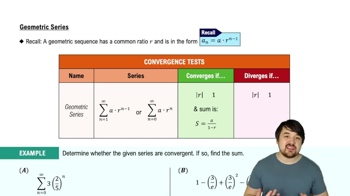
Geometric Series

Telescoping Series Technique

A telescoping series is one where many terms cancel out when the series is expanded, simplifying the sum. Recognizing the series as telescoping helps evaluate it by focusing on the first few and last few terms. This technique often complements geometric series arguments.
추천 영상:
가이드 코스
06:00
Geometric Series
관련 실천
교과서 질문

41–44. {Use of Tech} Remainders and estimates Consider the following convergent series.


b. Find how many terms are needed to ensure that the remainder is less than 10⁻³.


41. ∑ (k = 1 to ∞) 1 / k⁶

59
views

교과서 질문

{Use of Tech} Periodic dosing

Many people take aspirin on a regular basis as a preventive measure for heart disease. Suppose a person takes 80 mg of aspirin every 24 hours. Assume aspirin has a half-life of 24 hours; that is, every 24 hours, half of the drug in the blood is eliminated.


b.Use a calculator to estimate this limit. In the long run, how much drug is in the person’s blood?

44
views
교과서 질문

27–34. Working with sequences Several terms of a sequence {aₙ}ₙ₌₁∞ are given.

b. Find a recurrence relation that generates the sequence (supply the initial value of the index and the first term of the sequence).

{-5, 5, -5, 5, ......}

54
views
교과서 질문

Explain why or why not Determine whether the following statements are true and give an explanation or counterexample.


b. The sum ∑ (k = 3 to ∞) 1 / √(k − 2) is a p-series.

41
views
교과서 질문

57–60. Heights of bouncing balls A ball is thrown upward to a height of hₒ meters. After each bounce, the ball rebounds to a fraction r of its previous height. Let hₙ be the height after the nth bounce. Consider the following values of hₒ and r.


b. Find an explicit formula for the nth term of the sequence {hₙ}.


h₀ = 30,r = 0.25

69
views
교과서 질문

72–75. {Use of Tech} Practical sequences

Consider the following situations that generate a sequence


b.Find an explicit formula for the terms of the sequence.


Radioactive decay

A material transmutes 50% of its mass to another element every 10 years due to radioactive decay. Let Mₙ be the mass of the radioactive material at the end of the nᵗʰ decade, where the initial mass of the material is M₀ = 20g.

44
views