Ch. 10 - Sequences and Infinite Series
Briggs - Calculus: Early Transcendentals 3rd Edition
Briggs3rd EditionCalculus: Early TranscendentalsISBN: 9780136847243당신이 사용하는 게 아니라요?교과서 변경
10장, 문제 10.3.83

72–86. Evaluating series Evaluate each series or state that it diverges.
∑ (k = 1 to ∞) ((1/3) × (5/6)ᵏ + (3/5) × (7/9)ᵏ)

검증된 단계별 안내
1
Recognize that the given series is a sum of two separate infinite series: \( \sum_{k=1}^\infty \left( \frac{1}{3} \times \left( \frac{5}{6} \right)^k + \frac{3}{5} \times \left( \frac{7}{9} \right)^k \right) = \sum_{k=1}^\infty \frac{1}{3} \left( \frac{5}{6} \right)^k + \sum_{k=1}^\infty \frac{3}{5} \left( \frac{7}{9} \right)^k \).
Identify each series as a geometric series of the form \( \sum_{k=1}^\infty ar^k \), where \(a\) is the coefficient and \(r\) is the common ratio. For the first series, \(a = \frac{1}{3}\) and \(r = \frac{5}{6}\). For the second series, \(a = \frac{3}{5}\) and \(r = \frac{7}{9}\).
Check the convergence of each geometric series by verifying if the absolute value of the common ratio \( |r| < 1 \). Since \( \frac{5}{6} < 1 \) and \( \frac{7}{9} < 1 \), both series converge.
Use the formula for the sum of an infinite geometric series starting at \(k=1\): \[ S = \frac{ar}{1 - r} \]. Apply this formula to each series separately.
Calculate the sum of the original series by adding the sums of the two geometric series: \[ S_{total} = \frac{\frac{1}{3} \times \frac{5}{6}}{1 - \frac{5}{6}} + \frac{\frac{3}{5} \times \frac{7}{9}}{1 - \frac{7}{9}} \].

비슷한 문제에 대한 검증된 영상 답변:

이 영상 해법은 위 문제에 도움이 된다고 튜터들이 추천한 것입니다.
영상 길이:
3m
도움이 되었나요?

주요 개념

질문에 올바르게 답하기 위해 반드시 이해해야 하는 핵심 개념들은 다음과 같습니다.

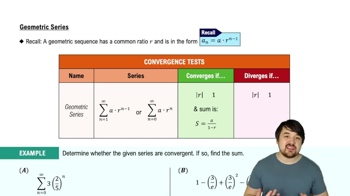
Infinite Geometric Series

An infinite geometric series is a sum of terms where each term is a constant multiple (common ratio) of the previous one. It converges if the absolute value of the common ratio is less than 1, and its sum can be found using the formula S = a / (1 - r), where a is the first term and r is the common ratio.
추천 영상:
가이드 코스
06:00
Geometric Series

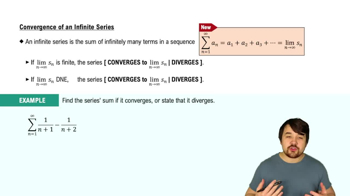
Convergence and Divergence of Series

A series converges if the sequence of its partial sums approaches a finite limit; otherwise, it diverges. For geometric series, convergence depends on the common ratio's magnitude. Understanding convergence is essential to determine whether the series sum exists or not.
추천 영상:
가이드 코스
06:52
Convergence of an Infinite Series

Linearity of Series Summation

The sum of a series that is a sum of two series equals the sum of each series separately. This property allows breaking down complex series into simpler parts, evaluating each independently, and then combining the results to find the total sum.
추천 영상: