Ch. 10 - Sequences and Infinite Series
Briggs - Calculus: Early Transcendentals 3rd Edition
Briggs3rd EditionCalculus: Early TranscendentalsISBN: 9780136847243당신이 사용하는 게 아니라요?교과서 변경
10장, 문제 10.3.87f

87. Explain why or why not
Determine whether the following statements are true and give an explanation or counterexample.


f. If the series ∑ (k = 1 to ∞) aᵏ converges and |a| < |b|, then the series ∑ (k = 1 to ∞) bᵏ converges.

검증된 단계별 안내
1
Step 1: Understand the problem statement. We are given that the series \( \sum_{k=1}^\infty a^k \) converges and that \( |a| < |b| \). We need to determine if this implies that the series \( \sum_{k=1}^\infty b^k \) also converges.
Step 2: Recall the convergence criteria for geometric series. A geometric series \( \sum_{k=1}^\infty r^k \) converges if and only if \( |r| < 1 \). If \( |r| \geq 1 \), the series diverges.
Step 3: Since \( \sum_{k=1}^\infty a^k \) converges, it follows that \( |a| < 1 \). This is because the series is geometric with ratio \( a \).
Step 4: Given \( |a| < |b| \), and knowing \( |a| < 1 \), it is possible that \( |b| \geq 1 \). If \( |b| \geq 1 \), then the series \( \sum_{k=1}^\infty b^k \) diverges by the geometric series test.
Step 5: Therefore, the statement is not necessarily true. A counterexample would be choosing \( a = 0.5 \) and \( b = 0.8 \) (both less than 1, so both series converge), but if \( b = 1.2 \), then \( |a| < |b| \) but \( \sum b^k \) diverges. Hence, the statement is false.

비슷한 문제에 대한 검증된 영상 답변:

이 영상 해법은 위 문제에 도움이 된다고 튜터들이 추천한 것입니다.
영상 길이:
2m
도움이 되었나요?

주요 개념

질문에 올바르게 답하기 위해 반드시 이해해야 하는 핵심 개념들은 다음과 같습니다.

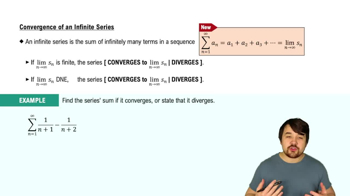
Convergence of Infinite Series

An infinite series converges if the sequence of its partial sums approaches a finite limit. For series involving powers, such as ∑ a^k, convergence depends on the value of the base a. Understanding convergence criteria is essential to determine whether a given series sums to a finite value.
추천 영상:
가이드 코스
06:52
Convergence of an Infinite Series

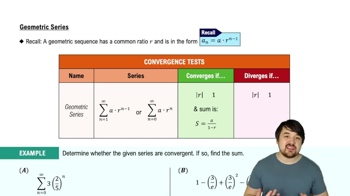
Geometric Series and Their Convergence

A geometric series ∑ r^k converges if and only if the absolute value of the common ratio |r| is less than 1. If |r| ≥ 1, the series diverges. This concept is crucial for analyzing series of the form ∑ a^k and ∑ b^k, as their convergence depends directly on the magnitude of a and b.
추천 영상:
가이드 코스
06:00
Geometric Series

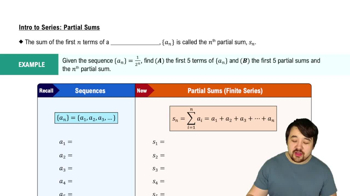
Comparison of Series Based on Term Magnitudes

Comparing series by the size of their terms can help infer convergence properties. However, a larger base in a geometric series does not guarantee convergence if the smaller base series converges. Understanding that convergence depends on the absolute value of the base, not just relative size, is key to evaluating the given statement.
추천 영상:
가이드 코스
06:45
Intro to Series: Partial Sums